
Editorial: Government of Decisions and Revisions !!!
Shimla Apr 07 Ritanjali Hastir
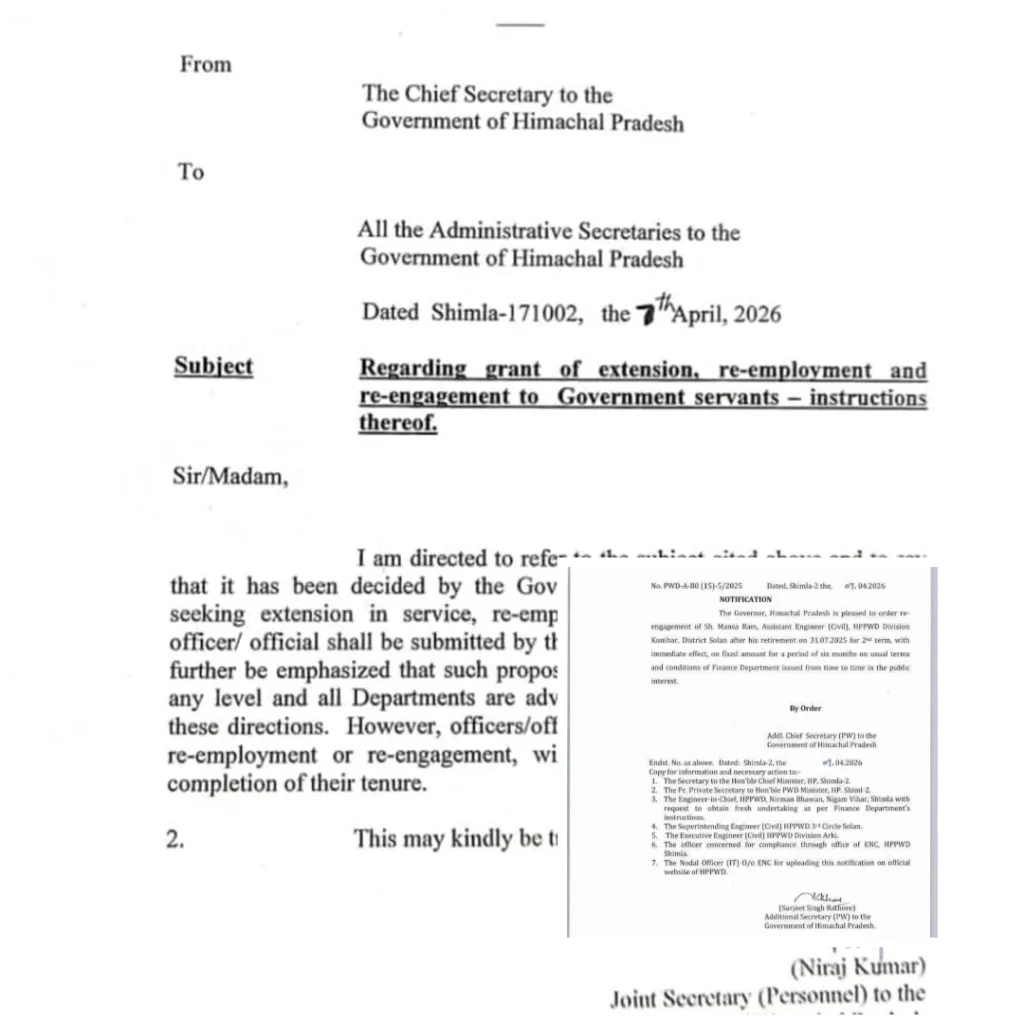
If governance were a sport, the Himachal Pradesh government would be winning gold in contradictions. On one hand, a “most urgent” directive from the Department of Personnel clearly states that no extension, re-employment, or re-engagement of government servants will be entertained at any level. A firm, sweeping, no-exceptions policy ; at least on paper.
And then, almost on cue, another department of the same government quietly proceeds to re-engage a retired officer.
Welcome to governance under Chief Minister Sukhvinder Singh Sukhu, where policy is declared with authority and diluted with remarkable speed.
The irony here is not subtle it is almost theatrical. A directive stamped “MOST URGENT” is expected to carry weight, to signal seriousness, to establish discipline across departments. Instead, it appears to have lasted just long enough to be contradicted. One cannot help but wonder whether the urgency was about implementation or about issuing the order itself.
This is not merely a bureaucratic inconsistency; it is a contradiction at the heart of governance. When one arm of the government says “no exceptions” and another creates one instantly, the message becomes unmistakable: policies are important, but not necessarily binding.
There is, of course, a certain efficiency in this approach. The system does not waste time debating or reviewing, it simply overrides itself. Decisions are taken, and then quietly untaken in practice. Files move, signatures appear, and somewhere in between, coherence disappears.
For the administrative machinery, this creates an unusual predicament. Should officials follow the written directive, or anticipate the unwritten exception? Should rules be treated as final, or as flexible suggestions subject to immediate revision? Governance, in such a scenario, begins to resemble interpretation rather than execution.
Chief Minister Sukhu had spoken of reform, of a more accountable and disciplined system. Yet, what is unfolding suggests a different reality one where coordination is fragile and consistency is negotiable. The gap between policy and practice is no longer a gap; it is a pattern.
And the cost of this pattern is not merely administrative embarrassment. It is the gradual erosion of credibility. When a government’s own orders fail to align with its actions, public confidence does not decline dramatically it fades steadily, replaced by scepticism and doubt.
To be fair, exceptions in governance are not uncommon. Situations arise that demand flexibility. But exceptions carry legitimacy only when they are transparent, justified, and consistent with broader policy. When they appear instantly and without explanation, they do not clarify policy they undermine it.
Himachal Pradesh today finds itself in a curious situation where the government is both firm and flexible, decisive and contradictory, all at once. It is a delicate balancing act—one that risks tipping into confusion.
Because in the end, governance cannot function on parallel tracks of declaration and deviation. A policy cannot be both absolute and optional. And a government cannot expect to be taken seriously if its most urgent decisions are the first to be set aside.
In this unfolding spectacle, the only certainty seems to be uncertainty. And that, perhaps, is the most urgent issue of all.
Samagra Sikhsha