
Lift to Shimla’s Pride or Descent into Civic Apathy?
Shimla, June 30 Ritanjali Hastir
Every hill town has its postcard moment. In Shimla, for thousands of visitors arriving at Cart Road, that moment is often the Tourism Lift—a simple ride that bridges the bustling lower town with the colonial charm of the Mall Road. Elderly tourists, families with children, people carrying luggage, and even locals use it every day. It is, in many ways, the city’s front door.
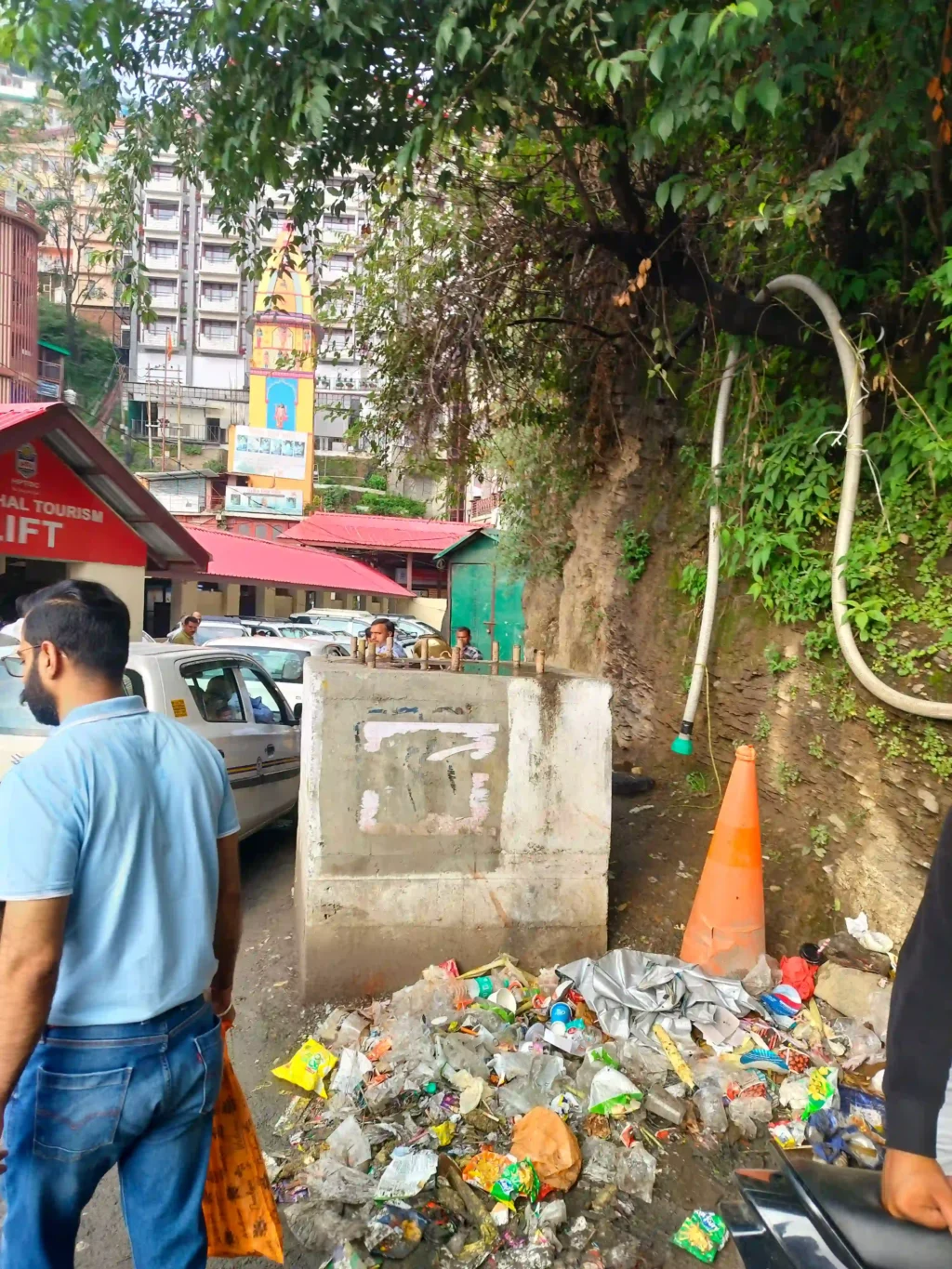
Unfortunately, a heap of garbage currently frames the front door.
Instead of crisp mountain air and the promise of a leisurely stroll on the Ridge, visitors are being greeted by overflowing waste dumped in the open at the entrance of one of Shimla’s busiest public facilities. Plastic bottles spill out of torn bags, disposable cups mingle with food wrappers, and the unmistakable sight and smell of neglect compete with the beauty of the surrounding hills.
It is hardly the welcome one expects from a city that has long marketed itself as the Queen of Hills.
Standing nearby, a resident could only shake his head and say, “Perhaps this is the welcome gift our tourists deserve,” he quipped with a smile that quickly faded. “Considering how many people casually litter around the city, maybe this is fitting. But jokes apart, it is painful. Every time something like this happens, it chips away at Shimla’s image. We keep talking about promoting tourism, but what impression are we really leaving?”
His remark may have been laced with humor, but it captured a frustration that many residents quietly share. Shimla’s cleanliness has increasingly become a seasonal talking point, especially during the peak tourist months, when overflowing bins and littered streets regularly make headlines. Yet seeing garbage piled up at the entrance of a facility specifically meant to make the city more accessible is a contradiction difficult to ignore.
For one visiting family, the experience was enough to puncture years of expectations.
“We have always imagined Shimla as a clean, beautiful hill station,” said a tourist waiting outside the lift. “Because we cannot walk long distances, we chose to use the Tourism Lift. But before we could even enter, we were welcomed by a huge pile of garbage lying in the open. It genuinely surprised us. We expected mountain views, not this.”
The irony is impossible to miss. Visitors travel hundreds of kilometers seeking fresh air, cool weather, and pristine surroundings, only to encounter an eyesore at one of the city’s most frequented public spaces. It is not merely about aesthetics. Such sights quietly shape perceptions of a destination far more than promotional brochures or tourism campaigns ever can.
The question, as always, is where responsibility begins and where it ends. It is easy to point fingers at the Municipal Corporation whenever garbage accumulates. Equally, it is impossible to ignore that waste does not appear overnight without human hands putting it there. Somewhere along the way, public spaces have become convenient dumping grounds, while the expectation remains that someone else will eventually clean up the mess.
Ward Councillor Sushma Kuthiala said she was not aware of the situation and assured that it would be addressed promptly.
“I wasn’t aware that garbage had accumulated there. I will get the matter resolved immediately. At the same time, I request citizens to remain vigilant. If they notice such situations, they should report them because one person can’t be present everywhere all the time,” she said.
Her response highlights the challenge confronting urban local bodies across hill towns. Monitoring every street corner is impossible, particularly during the tourist season when the city’s population swells dramatically. But the problem is not simply one of manpower or machinery. It is also about how quickly public spaces can deteriorate when accountability disappears the moment a piece of litter leaves someone’s hand.
For a city whose economy is built around tourism, seemingly small lapses carry disproportionate consequences. Visitors may forget the hotel they stayed at or the café where they had coffee, but they rarely forget the first impression a place leaves.
The Tourism Lift was built to make Shimla easier to experience. Instead, the garbage outside its entrance risks becoming an unintended landmark of a different kind, one that says more about civic neglect than civic pride.
Shimla deserves better than that. So do the people who call it home, and those who travel long distances hoping to see the Queen of Hills at her best.
Samagra Sikhsha