
Auckland Schools’ “Jacob’s Collection” : When Young Voices Paint What We Fear to Say
4 min read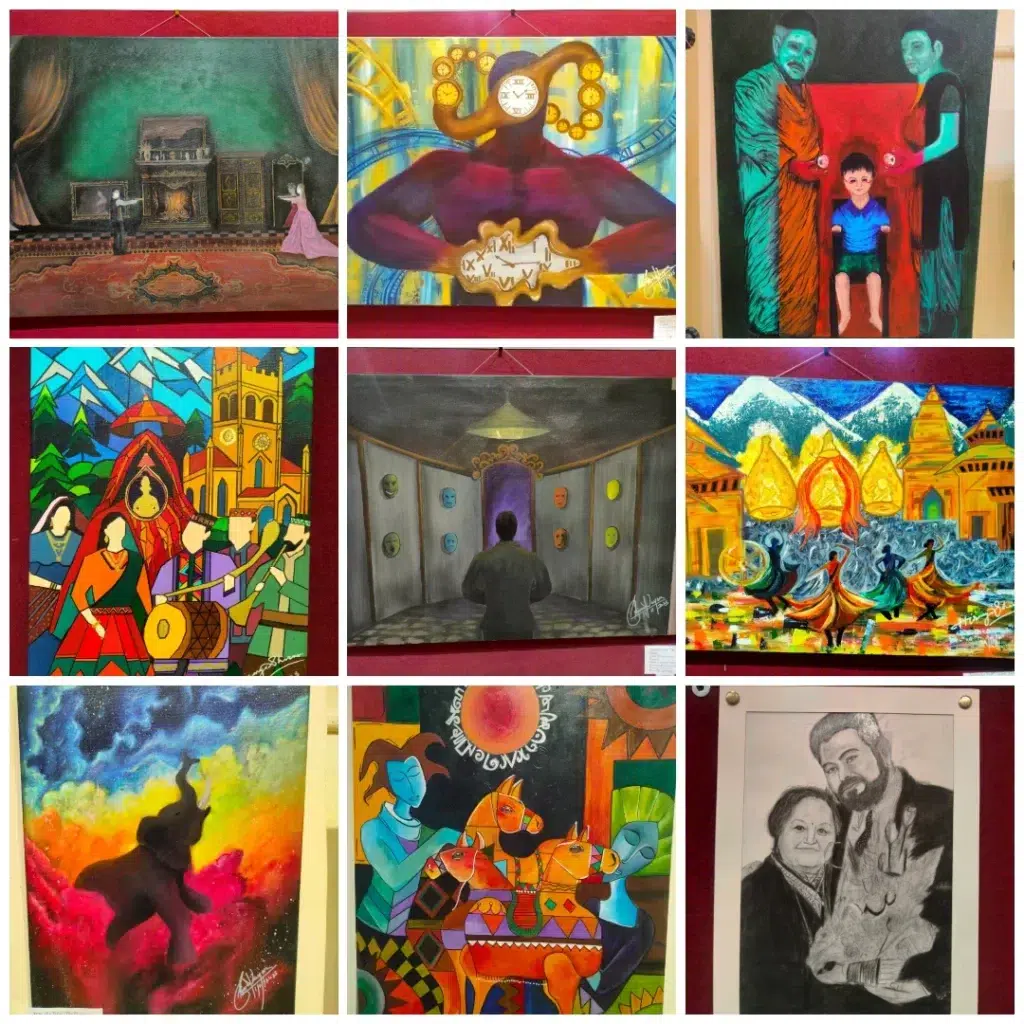
Shimla, Dec. 11, Ritanjali Hastir
When Auckland House School and Auckland House School for Boys opened The Jacob’s Collection at the Gaiety Theatre, the exhibition did not unfold like a routine school display. Instead, it felt like stepping into the inner weather of a generation—its storms, secrets, dreams, rebellions, and quiet awakenings. Nearly a hundred artworks, created by students from Classes 7 to 12, formed a living mosaic of their questions and convictions. Inaugurated by Michael A. John, the show carried the legacy of Jacob, the early Belvedere art collector whose name now frames a new lineage of young creators.
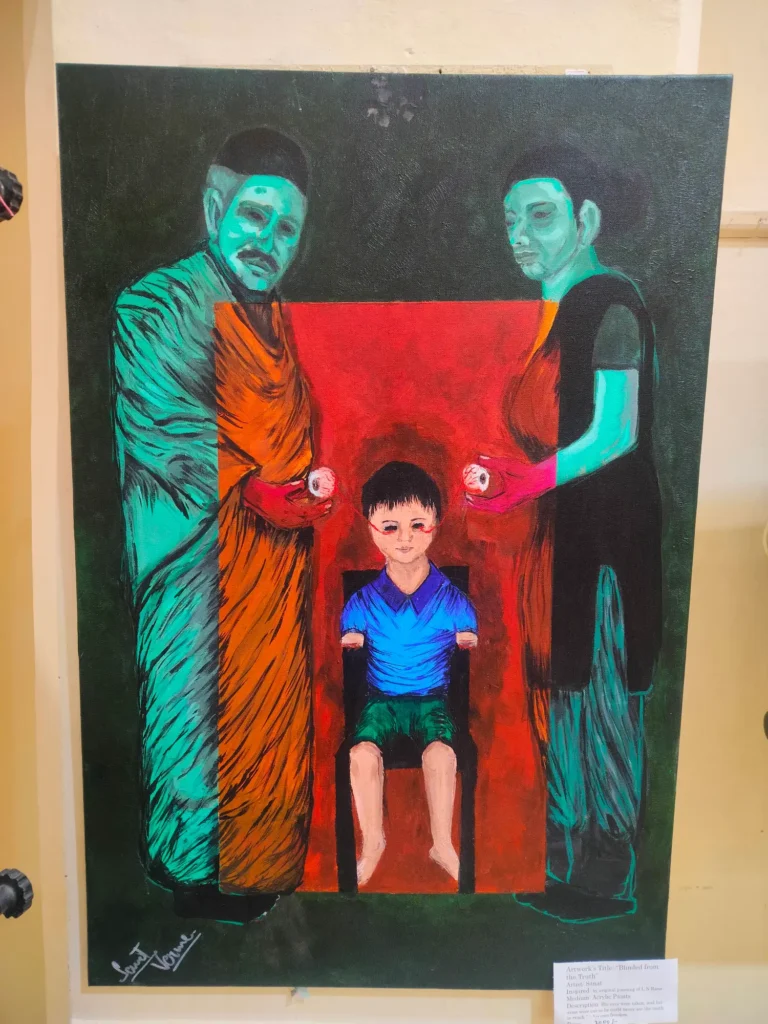
What struck visitors first was not technique, though the skill was undeniable. It was the courage. The willingness to enter unsettling emotional terrains and return with something honest. Akshit’s “The Question” pulled viewers into a moral freeze-frame: a trembling hand, a girl whose reflection mutates into something monstrous, and the impossible decision between perception and truth. Just a few steps away, Sanat extended this psychological unease—his “Blinded from the Truth” portrayed a figure robbed of agency, while “The Chess of Life” reduced society to a board where power is protected and the vulnerable are sacrificed. These were not children dabbling in metaphor; these were young artists holding up mirrors to the world, and the reflections were uncomfortable.
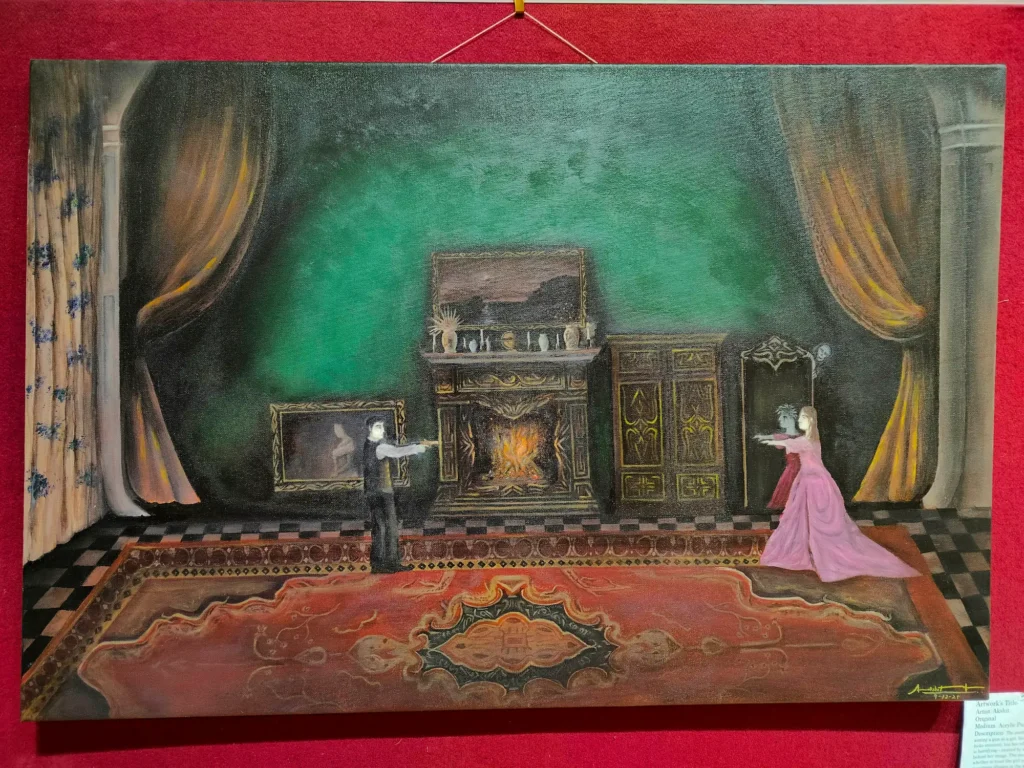
ShivamNayar’s works—the cryptic “Veiling Masks,” the temporal meditations in “Tales of Time,” and the stark vulnerability in “Time’s Slap” —added to this landscape of interior unrest. His canvases seemed to ask whether modern life allows anyone to remain unmasked, whether time is a companion or a quiet adversary. In their collective presence, these paintings formed a dark current running beneath the exhibition, a reminder of how deeply adolescence today is entangled with fear, awareness, and the desire to understand one’s own contradictions.
And then, almost like turning a page, the atmosphere shifted. The Girls’ School contributions brought a different intensity—less violent, but more piercing. Damini Sandhu emerged as one of the most evocative voices. “The Forgotten Window” glowed with the ache of lives lived behind curtains of silence. “The Yellow Wallpaper” , echoing the spirit of feminist literature, trapped its central figure within colours that become cages. “The Eternal End” softened the heaviness into transcendence, imagining death not as collapse but as a luminous continuation. Her paintings formed a quiet rebellion—artworks that refused to let marginalised narratives remain invisible.
Around her, others added their own whispers of courage. Anahita Verma’s “The Unheard Scream” held so much pain in its silence that viewers instinctively leaned closer. Aakriti Malketa’s dreamlike women—caught between clocks, shadows, and inner blooming —seemed to inhabit multiple emotional worlds at once. Anamya’s “The Universe Within” offered an unexpected calm: the idea that a person contains galaxies, that meaning expands rather than collapses upon inspection.
Yet the exhibition wasn’t only introspection. It also carried the rhythm of culture and place. Hiranya Sharma’s works—bursting with dancers, deities, mountains, and Himachali colour—felt like festivals captured mid-motion . Sayam’s blue-toned tranquility and his luminous “Sailing Through Colour” offered a breathing space after the intensity of earlier works. Diva Mehta’s gentle “Still Swimming” portrayed resilience not as triumph, but as the quiet act of continuing.
Even the contemporary anxieties of this generation found shape—Nitin’s commentary on media distortion , Parija Sood’s intricate reflections on information overload and the fragility of memory —artworks that revealed how deeply digital noise hums in the background of young lives.
As visitors moved through the gallery, a strange harmony emerged. Despite the contrasts—darkness to colour, confinement to expanse, rebellion to reflection—the exhibition felt cohesive. It flowed the way rivers do when fed by many tributaries: different in tone, united in destination.
Michael A. John’s words at the inauguration seemed to settle softly over the entire collection. The students, he said, were not merely producing art but revealing imagination shaped by discipline, courage, and guidance. And indeed, the exhibition seemed less like a display of what they had learned and more like an unfolding of who they are becoming.
In the end, The Jacob’s Collection became an experience rather than an event. A conversation between young minds and an old city. A testament to how deeply students can feel, interpret, and question the world around them. And as visitors stepped back into the cold Shimla air, many carried the same lingering thought: these were not just artworks by students. They were windows—sometimes clear, sometimes unsettling—into a generation that has learned not only to see, but to look inward and outward with startling honesty.