
Uneven Notes, Powerful Crescendo: Pratibha Natya Utsav Review
Shimla, March 31 Ritanjali Hastir
The Pratibha Natya Utsav at Gaiety Theatre unfolded as a blend of uneven storytelling and compelling theatrical brilliance, culminating in a memorable finale
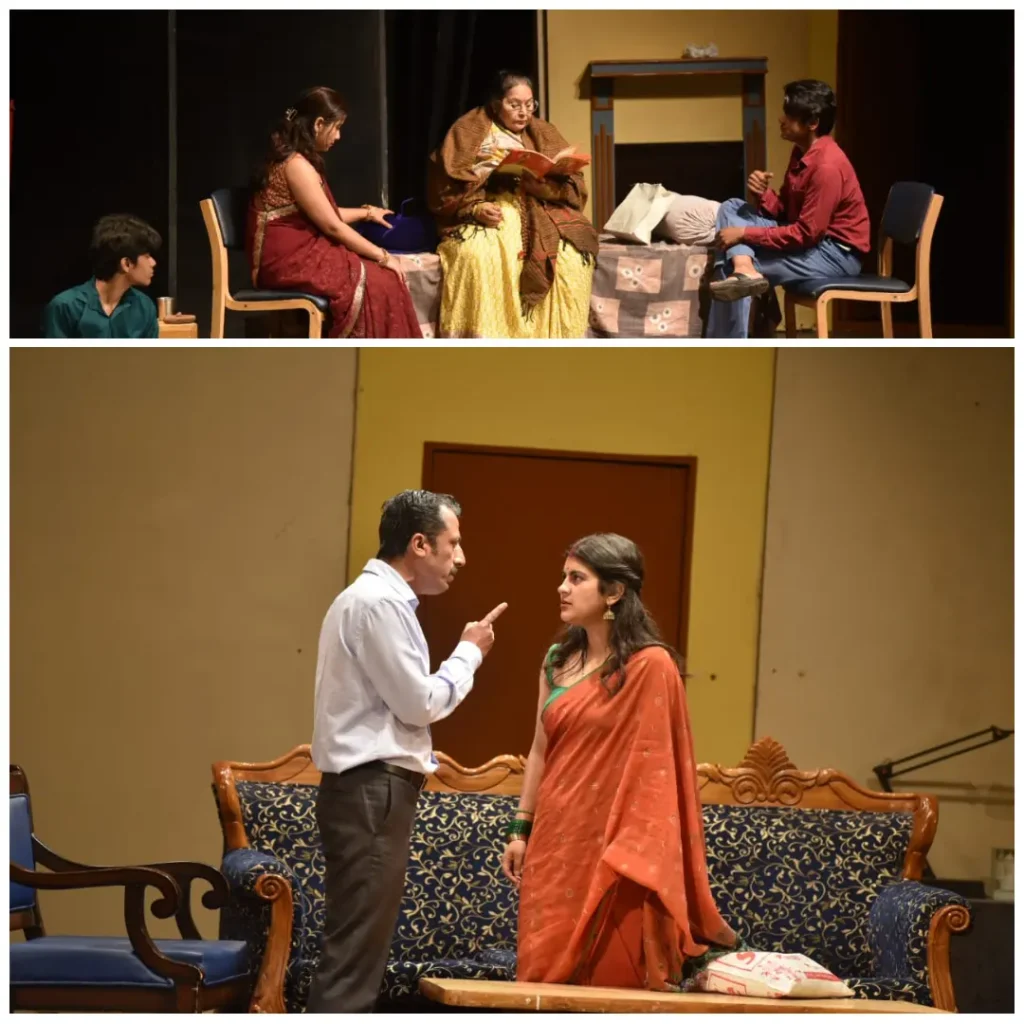
The opening play “Apne Apne Daav” can be termed as “A Missed Opportunity,” as despite being rooted in the familiar terrain of family conflict and social commentary, Apne Apne Daav struggled to rise above a run-of-the-mill script. The narrative lacked depth and offered little novelty, making it difficult for the audience to remain invested.
What could have salvaged the production was strong, immersive acting, but unfortunately, the performance largely fell flat. The portrayal of the grandmother (Bua Dadi) was particularly underwhelming; her delivery felt mechanical, as she was directly reading her dialogue from the prayer book she held, with her voice barely audible most of the time.
The two-hour runtime further exacerbated the issue. Poor pacing, prolonged pauses, and unnecessary drag diluted the impact, turning what could have been a crisp narrative into a tedious experience.
However, not all was lost. The actors portraying the father and the neighbour brought moments of relief with their natural performances. The real highlight came unexpectedly in the final stretch, where the distant relative (Bua-Dadi) infused life into the narrative. His presence in the last fifteen minutes briefly revived the otherwise fading production, offering a glimpse of what the play could have been.
On the other hand, in stark contrast, ‘Man Ke Bhawar’, directed by Rupesh Bheemta, emerged as the strongest production of the festival.
Despite its dense and psychologically layered script, the play succeeded in maintaining a firm connection with the audience. The protagonist delivered a gripping and nuanced performance, carrying the weight of the narrative with remarkable control. The actor portraying his wife complemented him effectively, ensuring the emotional tempo remained intact throughout.
A special mention must go to Ashok, whose brief appearance, lasting barely a few minutes, left a lasting impression. His subtle yet impactful performance demonstrated how even a short stage presence can resonate deeply when executed with precision.
That said, the production was not without flaws. The transition in setting—particularly the shift to Lucknow—lacked convincing visual distinction. Apart from a symbolic change, such as the photograph of the dead mother, most props remained unchanged, including the skipping rope, slightly weakening the intended spatial shift.
Yet, these shortcomings were overshadowed by the powerful climax, where the protagonist’s performance reached an emotional crescendo. It was this intensity that ultimately defined the play.
The standing ovation at the end was well deserved—not just for the acting but for the directorial vision. Rupesh Bheemta, while also playing the lead, managed to deliver a cohesive and impactful production, a feat that speaks volumes about his command over both performance and direction.
The festival, while uneven in parts, ultimately reaffirmed the enduring strength of theater. Apne Apne Daav faltered under weak execution despite familiar themes, whereas Man Ke Bhawar demonstrated how strong performances and directorial clarity can elevate even the most complex scripts into a memorable theatrical experience.
Samagra Sikhsha