
Two-day hybrid summit brought together academicians, researchers, and industry experts from India and abroad
Solan, November 27
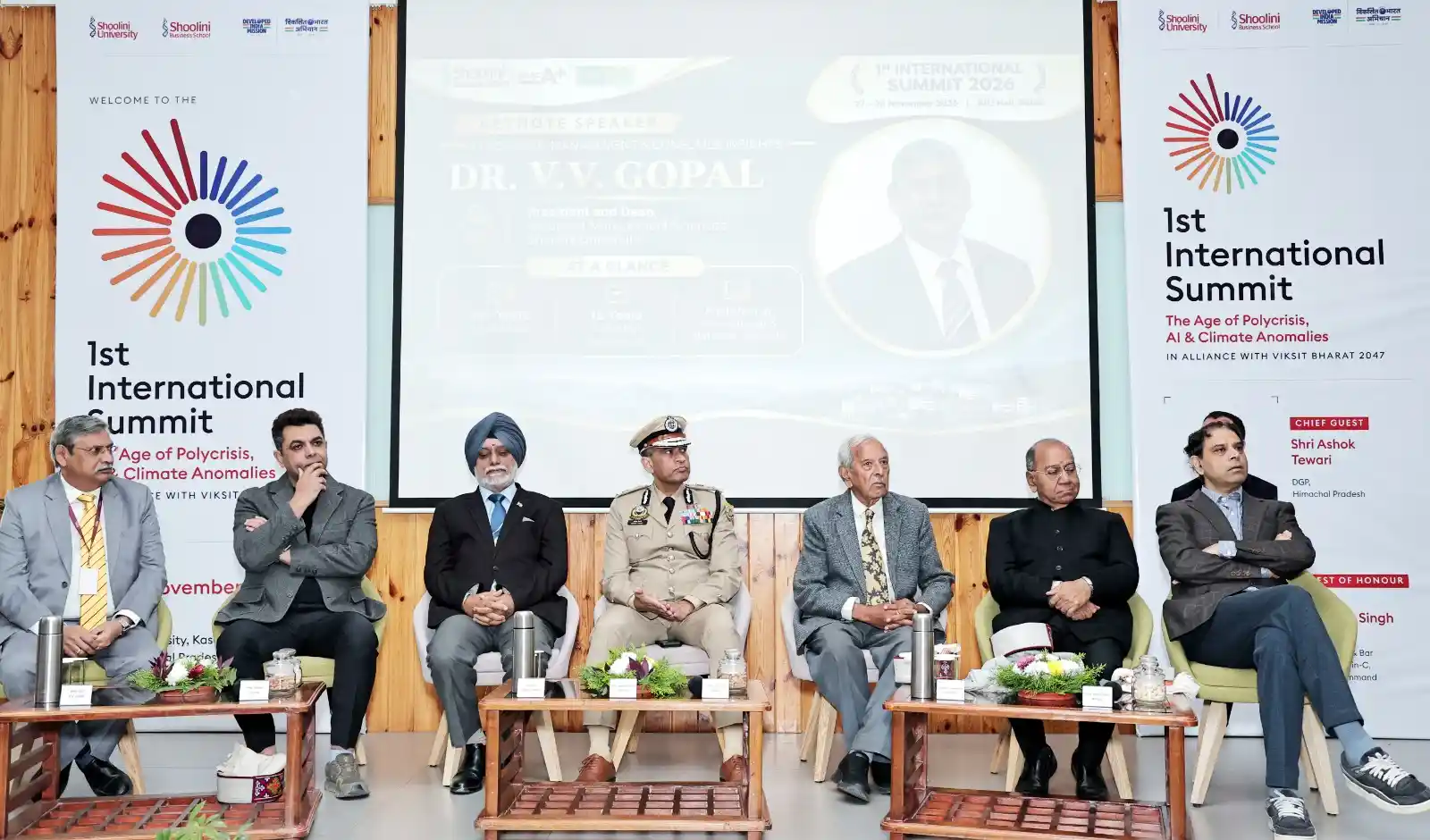
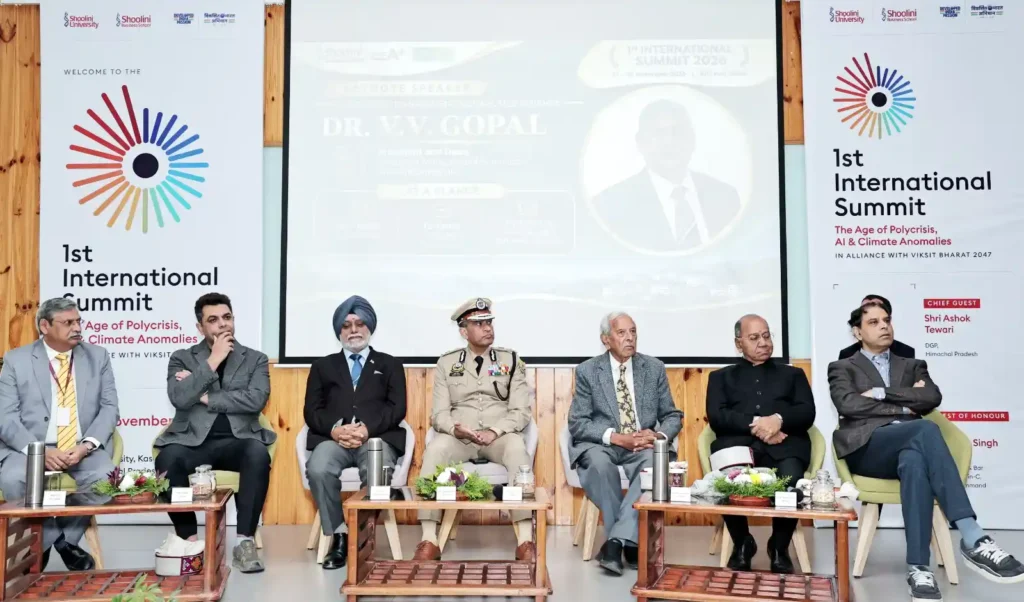
Shoolini Business School, at Shoolini University, inaugurated its 1st International Summit on “The Age of Polycrisis, AI and Climate Anomalies in Alliance with Viksit Bharat 2047”. The two-day summit, which began today in hybrid mode, brought together academicians, researchers and industry experts from India and abroad to examine how artificial intelligence and an increasingly erratic climate must be understood together, and what they mean for India’s journey to Viksit Bharat 2047.
The summit received 123 research papers, including 23 international submissions. Delegates and keynote speakers came from IIT Jammu, Panjab University, the University of Delhi and other leading institutions in India and overseas, joining both on campus and online. The summit was convened by Prof VV Gopal, President and Dean, Shoolini Business School, and Dr Nikhil Bhardwaj, Director, Doctoral Studies. The successful conduct of the summit was made possible by the dedicated efforts of the PG Director, the UG Director, the Doctoral Research team, and the faculty and staff of Shoolini Business School, who worked tirelessly behind the scenes.
Ashok Tewari, IPS, Director General of Police, Himachal Pradesh, graced the inaugural session as Chief Guest, while Lt Gen KJ Singh (Retd), former Western Army Commander, attended as Guest of Honour.
Addressing the summit’s theme, Chief Guest Ashok Tewari said, “Polycrisis occurs when multiple crises interact and amplify one another. In Himachal Pradesh, a weather crisis can quickly become an infrastructure crisis, while AI-generated misinformation can create public panic. Our problems are interconnected, yet our institutions work in silos. The challenges of tomorrow cannot be solved within institutional boundaries.” He added that realising the vision of Viksit Bharat 2047 required combining technological strength, institutional collaboration and human values to make development “faster, smarter, fairer and more equitable.” He also spoke on the importance of the UN Sustainable Development Goals (SDGs).
Guest of Honour Lt Gen KJ Singh (Retd) spoke on the challenges of polycrisis and technological disruption. “We are living in a world of cascading chaos, where understanding geostrategic realities and harnessing emerging technologies is crucial. Rather than fearing AI, we must learn to harness its potential.
Welcoming the delegates, Prof VV Gopal said, “Global conflicts have far-reaching implications for our lives and livelihoods. The response to this summit reflects a shared commitment to addressing these challenges through research and academic dialogue. Our future depends not on predicting crises, but on our ability to adapt to them and turn challenges into opportunities.”
Prof Vishal Anand, Pro Chancellor, Shoolini University, said India must leverage research, innovation and international collaborations to build a resilient and self-reliant economy in an era of global disruption. “Let AI perform the tasks while we think beyond it. At Shoolini, our vision is to generate intellectual property and develop products from India for the world, contributing to the vision of Viksit Bharat 2047,” he said.
Prof Ashish Khosla, President, AI and Innovation, Shoolini University, observed that AI was challenging the very fundamentals of management. “From warfare and medicine to driverless cars, AI is transforming the way the world operates. For the first time in human history, we have another form of intelligence challenging human thinking,” he said. He noted that India, as a knowledge-based economy, had immense opportunities to leverage AI and economies of scale, but urged students to build skills beyond conventional learning, question established management principles and identify the entrepreneurial opportunities emerging from this transformation.
Prof Arundeep Ahluwalia of Panjab University highlighted the link between climate and governance. “Climate is political and vice versa. To build a sustainable, future-ready India, we need to generate societal interest and excitement in Earth and environmental sciences,” he said. Pointing out that India does not yet have a UNESCO-recognised geopark, he expressed hope that Shoolini would one day become one. “To pollute the environment, cut down trees and destroy mountains is anti-national. It is time we raised our voices against these practices,” he added.
Over two days, the summit featured keynote addresses, research paper presentations and academic discussions on polycrisis, artificial intelligence, climate anomalies and their combined impact on India’s development agenda.
Samagra Sikhsha