
Editorial: LAC Independent Academy Yet Dependent Structure
4 min read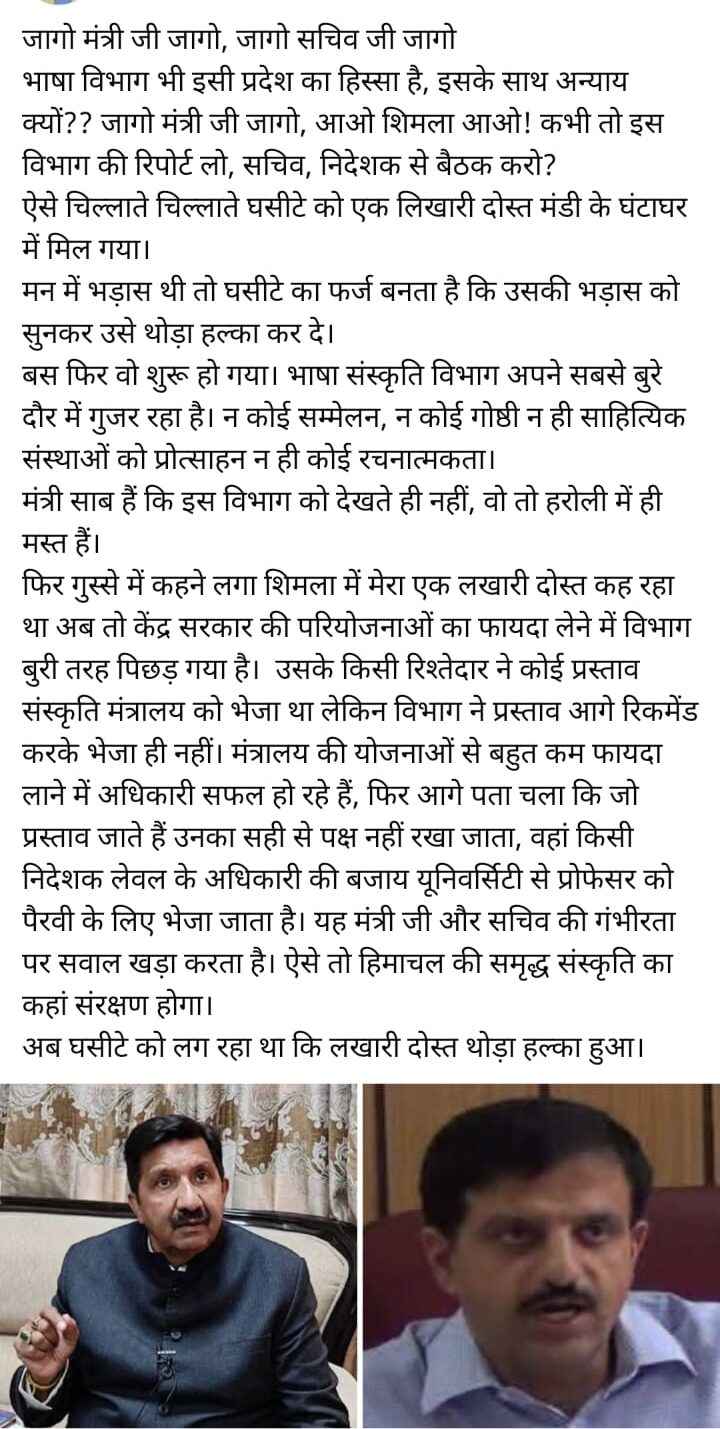
Screenshot From Social Media
Shimla, March 01, 2026 Ritanjali Hastir
The Himachal Pradesh State Academy of Art, Culture and Language was established as an independent body with a clear mandate: to preserve linguistic heritage, promote scholarship, and strengthen the cultural foundations of the state. More than five decades later, its structural independence remains intact on paper, but its functional vitality appears steadily diminished.
The Academy operates in an environment where essential research and technical posts have remained unfilled for years. There are no sustained research appointments in core disciplines such as Hindi, Sanskrit, Fine Arts, or Performing Arts. There is no serious digital archiving framework. Documentation, preservation, and modern dissemination demand professional expertise, yet the positions that would support such work have not been strengthened in any meaningful way.
At the same time, the broader Department of Language, Art and Culture maintains a layered administrative structure consisting of four Additional Directors, two Deputy Directors, one Joint Directors and one Director (HAS and IAS ranked). The contrast is difficult to overlook. While the Academy lacks technical depth and research manpower, and is mostly dependent on the clerical staff for the entire work. The result is a visible imbalance between hierarchy and intellectual production.
The workforce profile within the system further underscores this stagnation. A significant number of employees are nearing retirement, and the retirement age of 62 continues to be applied within the Academy structure. Experience has value, but institutional continuity requires renewal. Without timely recruitment of scholars, researchers, and technical professionals, generational transition becomes institutional decline. An academy cannot rely indefinitely on ageing staff without investing in intellectual succession.
The prolonged absence of a full time Secretary has compounded the problem. Leadership assigned as an additional charge inevitably limits long term planning and sustained oversight. Cultural institutions require consistent administrative direction aligned with academic vision. Without that alignment, routine functioning replaces strategic growth.
Public money supports this entire framework. Salaries are disbursed, offices are maintained, and administrative designations remain secure. However, when technical posts remain vacant for years and research structures are not revitalized, questions arise about the efficiency of resource allocation. Cultural governance cannot be measured solely by the existence of posts; it must be evaluated by output, scholarship, documentation, and outreach.
The duplication of operational space between the Department and the Academy also weakens clarity of purpose. Both function along similar lines, yet the Academy, despite being an independent body, lacks the infrastructural strength that would justify its autonomy in practice. Independence requires not only statutory status but also operational capacity.
The resignation of senior literary figure S.R. Harnot from the body adds another layer of concern. When respected cultural voices disengage, it reflects dissatisfaction that goes beyond procedural disagreements. Institutional credibility is sustained through the confidence of its intellectual community, and that confidence appears strained.
For fifty three years, the Academy has struggled not merely for infrastructure but for structural coherence. Promised expansions remain incomplete. Research posts remain stagnant. Technical modernization has not kept pace with contemporary standards. Meanwhile, the administrative superstructure continues to function without visible reform.
An independent academy must operate as a centre of scholarship, not as an adjunct surviving within an administrative grid. Cultural preservation demands investment in people, expertise, and long-term planning. Without those elements, independence becomes symbolic rather than substantive.
The Academy presently falls under the administrative ambit of Chief Minister Sukhu as President and Deputy Chief Minister Mukesh Agnihotri as the Vice President of the academy. Under their watch, however, the institution appears to be receiving what many in the literary community describe as a foster treatment rather than committed stewardship. The sense of distance between policy authority and cultural reality has become increasingly evident. Writers, scholars, and artists who are directly or indirectly associated with the Academy speak not with anger alone, but with fatigue. There is a growing perception that their institution is being managed administratively but not nurtured intellectually. Over time, that perception has translated into disappointment, and disappointment into a quiet erosion of hope.
The institutional vacuum becomes even more apparent when one recalls that Dr. Prem Sharma served as Vice Chairman of the Academy from 2012 to 2017 during the tenure of then Chief Minister Raja Virbhadra Singh. Since then, successive governments, including the present one, have not moved decisively to restore similar leadership strength within the structure. Whether this prolonged reluctance stems from administrative indecision, political caution, or an unwillingness to invite sharper institutional accountability is open to interpretation. What remains undeniable is that an independent cultural body functions best when it has clearly designated leadership entrusted with responsibility and answerability. The absence of such appointments over an extended period inevitably weakens both direction and transparency, leaving the Academy operationally active but strategically adrift.
If financial limitations are indeed the central obstacle to filling research and technical posts, modernizing archives, and revitalizing scholarship, then administrative rationality demands reallocation. If culture cannot be meaningfully funded, then the surplus layers of direction may perhaps find more productive engagement in departments where adequate budgets exist and where their designations can generate measurable outcomes. It would, at the very least, align expenditure with functionality.
An academy without scholars cannot safeguard literature. A department without conviction cannot preserve language. And an administrative structure that sustains hierarchy while allowing substance to diminish risks protecting positions more effectively than it protects culture.