
Forest Department signs MoU with ISB’s Bharti Institute to realise Rs. 22,600 crore forest economy potential
SHIMLA 20 August, 2026
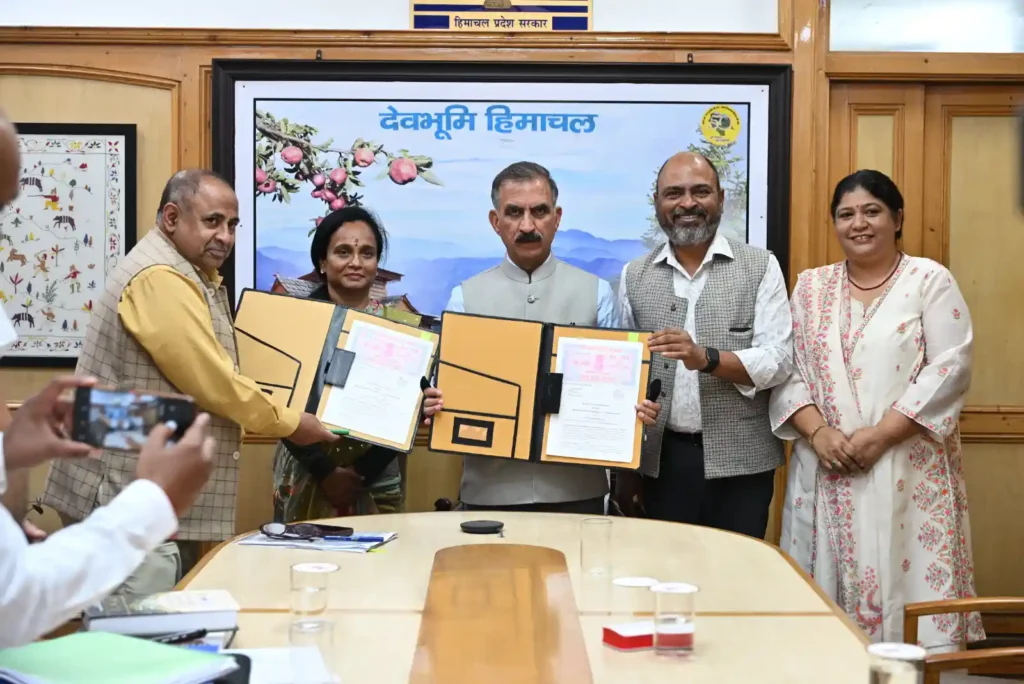
The Himachal Pradesh Forest Department signed a five-year MoU with the Bharti Institute of Public Policy, Indian School of Business (ISB-BIPP), in the presence of Chief Minister Thakur Sukhvinder Singh Sukhu here today to realise the State’s untapped forest and pastoral economy through science and technology-enabled governance.
The MoU was signed by Principal Chief Conservator of Forests Dr. Sanjay Sood on behalf of Forest department and Executive Director, BIPP, ISB Prof. Ashwini Chhatre on behalf of the Organization.
Speaking on the occasion, the Chief Minister said this partnership between the Forest department and ISB-BIPP is a vital step towards strengthening Himachal’s rural economy and will benefit the state for years to come. ‘We are well-positioned to be among the first in the country to bring science, local communities and the government together to transform forest governance. As we build on this momentum, I look forward to expanding this initiative to maximize the potential of abundant local species, such as medicinal plants like harad and bel and further assessing the nutritional and commercial value of thangi’ (hazelnut) said the Chief Minister.
Ahead of the signing the MoU, the team of ISB-BIPP presented findings from a joint forest inventory, wherein over 500 forest guards collected more than 2,00,000 tree-level records and species-tagged images, combined with satellite imagery and AI/ML, then validated on the ground. Maps have been generated for seven species including khair, bamboo, chir pine, amla, wild mango, sal, and rhododendron published jointly as ‘counting green wealth’.
The inventory estimates Rs.22,600 crore in untapped value across five bio-resources: amla ( Rs.8,700 crore), pine needles (Rs.5,500 crore), wild mangoes (Rs.4,800 crore), sal seeds (Rs. 2,400 crore) and rhododendron flowers ( Rs.1,200 crore), with extraction restricted to a sustainable, species-wise ‘yield sweet spot.’
The Pir Panjal Jungle Producer Company in Pangi, a women-owned enterprise in the thangi (hazelnut) business, was presented as a working example. The data already feeds Palampur Forest Division’s working plan, the first such instance, and the MoU will extend this to further Divisions eventually covering the entire state.
This partnership reflects what is possible when rigorous science is grounded in field reality. Over 500 forest guards spent months gathering this data, giving the estimates real credibility for economic decisions, said Prof. Ashwini Chhatre, while signing the MoU.
‘The data doesn’t stop at a report. It’s already shaping Palampur’s working plan, and this MoU extends that intelligence layer and the grazing database, state-wide’, said Dr. Aarushi Jain, Director, Bharti Institute of Public Policy, ISB, who was also present at the signing ceremony.
The MoU covers four areas: Forest Economy and Community Enterprises, building women-led Producer Companies and market linkages; a Forest Intelligence Platform, piloted in Palampur before state-wide rollout; a grazing portal and pastoral database under the Himachal Pradesh Grazing Policy, 2026, linked to Aadhaar, Him Pariwar, Bharat Pashudhan and the PEHEL scheme and training and capacity building for Forest department staff and producer companies.
Principal Secretary Forest M. Sudha Devi, Principal Chief Conservator of Forests Sanjay Sood, Executive Director, BIPP, ISB Prof. Ashwini Chhatre, Director (N), HP State Forest Development Corporation, Dharamshala Patil Nitin Kundalik and State Coordinator, BIPP, ISB, Neha Chakravarty were also present on the occasion.
Samagra Sikhsha