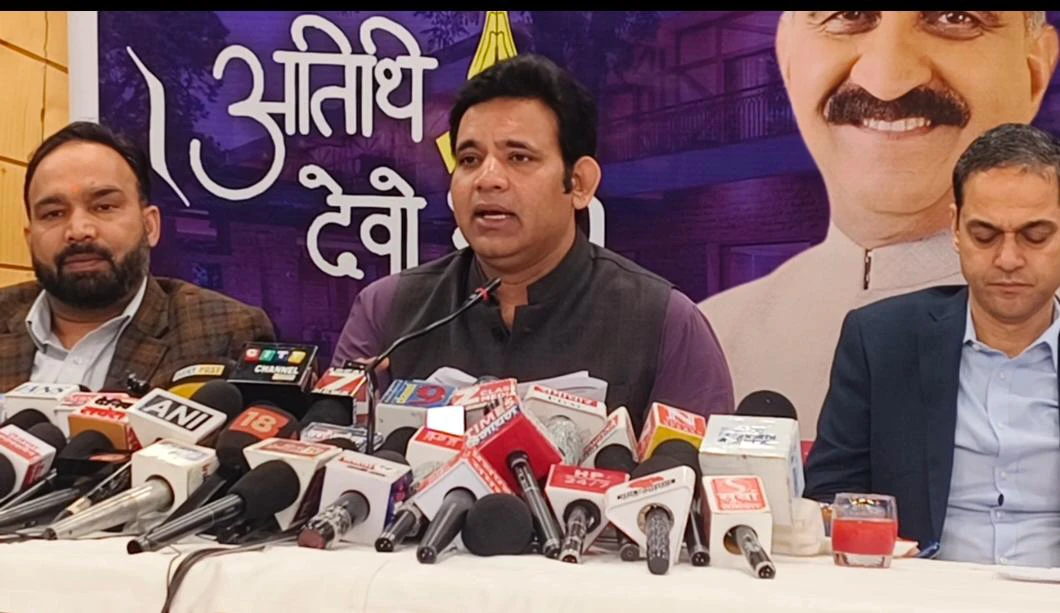

Thoroughly Anti People, Anti Federal Budget : Sanjay Chauhan
5 min read
Shimla, February 01, 2026
The ninth Union Budget presented by the Finance Minister in Parliament today was a stark testimony to the uncritical commitment of the Modi Government to promoting the narrow interests of a few big business houses and the rich and the wealthy, at the cost of the working people and socially oppressed sections of society, as well as larger national economic interests. The ‘fiscal discipline’ that Nirmala Sitharaman claimed as a credit for the Government has always been another way of describing tax concessions to the corporate sector and the rich, while squeezing expenditures necessary for improving the conditions of the working people. This has expressed itself in the current year and the budget for next year by a massive contraction
in revenues and slashing of expenditure.
In 2025-26, the year that is now ending, tax revenue realizations have fallen far short of even the modest estimates made in last year’s budget – even though part of the shortfall in income taxes and in GST revenues were quietly compensated by growth in excise duties which fall mainly on oil. The FM took no note of this crisis in revenues, and what they reflect about the underlying economy, and omitted to even mention the revenue implications of the tax proposals she announced. Their reality, however, is obvious from the fact that the anticipated revenues for 2026-27 are almost the same as in the Budget estimates for 2025-26 – which in effect means a sharp decline in the proportion of national income received as revenue.
Meeting the objective of reducing the fiscal deficit in such circumstances, in 2025-26 and 2026-27, has to obviously rely on cutting expenditures – and a naked assault on peasants and workers is the way in which this is being achieved. Compared to the Budget Estimates of 2025-26, expenditures have been drastically reduced under several Central and Centrally Sponsored Schemes – like Rasthriya Krishi Vikas Yojana, PM POSHAN, PM-SHRI, PM-JAY, PM-MSY, PMAY (Rural and Urban), Crop Insurance Scheme, etc. Allocations for welfare of Scheduled Castes, Scheduled, Tribes, and North Eastern Areas have also experienced cuts. Also there has been a slashing of expenditures for Agriculture and Allied Activities, Rural Development, Education, Health and Social Welfare. The Gender Budget has been slashed by Rs. 51,144 crores. In the coming year, 2026-27, further cuts are proposed in fertilizer, food and petroleum subsidies. This represents specially an attack on agriculture at a time when government data itself shows that the agriculture sector is facing a deflationary situation or a collapse of price realizations for the output produced.
Even the much touted increase in capital expenditures have fallen victim to the expenditure cuts, with revised estimates for 2025-26 being lower than budgeted. On the other hand, the capital expenditures through resources of public enterprises were lower in 2025-26 than in 2024-25 and are budgeted to remain lower even in 2026-27.
State Governments and their ability to meet the aspirations of their people are also being choked by the Modi Government’s approach. The transfers to states under centrally sponsored schemes, finance commission grants, and other transfers has been cut by 2,03,801 crores in 2025-26 as compared to the Budget Estimates. The Budget estimates for 2026-27 shows further a drop of Rs. 59,456 crores compared to 2025-26 Budget Estimates. This is taking place at a time when states are facing a severe financial crunch due to poor GST revenue realizations and the VB-G RAM G has already imposed an effective cut on state’s resources by shifting part of the burden of expenditure on to them.
The Finance Minister in her budget speech mentioned that the Modi government’s tenure has been marked by ‘stability, fiscal discipline, sustained growth, and moderate inflation’. What she failed to mention was that the only stability has been in the distress of the working people marked by rampant unemployment and limited earnings from work, while ‘sustained growth’ has marked only the incomes and wealth of the rich and the corporate sector. It is this growing inequality that Budget 2026-27 is going to further promote and further aggravate the crisis that is afflicting the Indian economy. It is also a woefully inadequate response to the issues arising from what is happening in the world economy.
In the union budget the interests of small and hill states like Himachal Pradesh are totally ignored. Himachal Pradesh is a revenue deficit state and under severe economic crises. In this budget the finance minister has not given anything to the State and even the revenue deficit grant due to the State under 16 th Finance Commission is not mentioned clearly and as per the demand made by the government. The state has suffered big losses in disasters due to heavy rains after 2023. As per the assessment done by the state government the losses due to disaster in the year 2023 and 2025 are more than Rs.18000 crore. Despite repeated demand made by the state government to the Central Government to give a special package for disaster mitigation no grant is given. Even in the present budget there is no mention to give grant in lieu of the losses due to the disaster.
Horticulture and tourism are the two core sectors who contribute to the economy of the state. The tourism and horticulture sector is totally ignored in the budget presented by the Finance Minister. After the Free Trade Agreement(FTA) with New Zealand and the European Union the import duty has been lowered which has very drastic consequences and the livelihood of lakhs of apple farmers is jeopardized. The Modi Government has mortgaged the interest of the Apple farmers while going through these agreements. Moreover, Market Intervention Scheme (MIS) was reduced from Rs. 1500 crore to meager amount of Rs. one lakh there is no mention to increase the budget for Market Intervention Scheme also in this budget.
Tourism in Himachal Pradesh is in bad shape due to poor connectivity and the disaster due to heavy rains. In the budget there is no mention of development of air and rail connectivity in the state. Even the road network is not in a better condition, in this situation the tourism cannot be boosted. The Finance Minister has mentioned to develop tracking and hiking trails in Himachal and other mountainous states but without any proper air, rail or road connectivity it’s not possible to bring this on the ground. The Finance Minister should have provided budget to develop better connectivity in the state.