
From Classical Texts to Social Themes: Reviewing Four College Plays at Gaiety
4 min read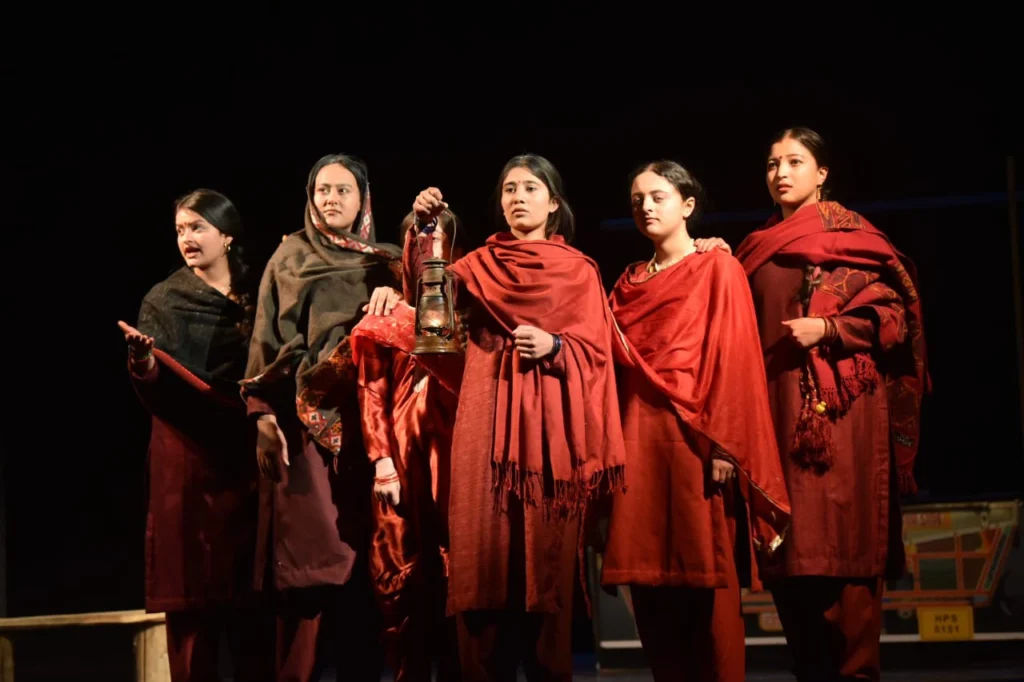
Shimla Jan 01, 2026 Ritanjali Hastir
During the Winter Carnival Theatre Festival, young talent from various colleges was given an opportunity to perform at the historic Gaiety Theatre, Shimla. The opening play, Mahroon, directed by Ajay Sharma and overviewed by Dr. Anurita Saxena, Principal, RKMV College, was based on a story inspired by a work of Dr. Yashodhara Mishra.
The play revolved around the story of a woman who falls in love with a man after her marriage—a theme that holds inherent emotional and social complexity. However, the director failed to bring out the bold, daring, and conflicted inner world of a woman who defies societal norms and falls in love with a Sadhu. Throughout the performance, the storyline lacked clarity and coherence, appearing more like loosely stitched scenes rather than a continuous narrative.
The dominant use of maroon in the costumes, intended to symbolise passion, power, and intensity, remained largely superficial. This visual motif could have been explored more imaginatively—especially at the moment when Sati speaks of every woman possessing a “vardaan,” which might have been metaphorically transformed into the life-giving power of womanhood. Unfortunately, such symbolic possibilities remained unexplored.
Overall, the play remained bald in its treatment and failed to leave a meaningful impact. Instead of evolving into a layered theatrical experience, it often resembled a bhashan pratiyogita, with characters repeatedly delivering overt social messages on equality. Even the Karyala sequence did not add depth or dramatic strength, falling short of supporting the director’s intended vision.
While the intent was earnest, Mahroon struggled to translate its thematic ambition into effective stagecraft, leaving much of its potential unrealised.
Next came Abhigyan Shakuntalam, written by Kālidāsa and performed by students of the Sanskrit College under the guidance of Dr. Mukesh Sharma, with direction by Acharya Vinod Sharma. Based on the timeless and celebrated story of Shakuntala, the choice of text itself carried immense promise, drawing from one of the finest works of classical Indian literature.
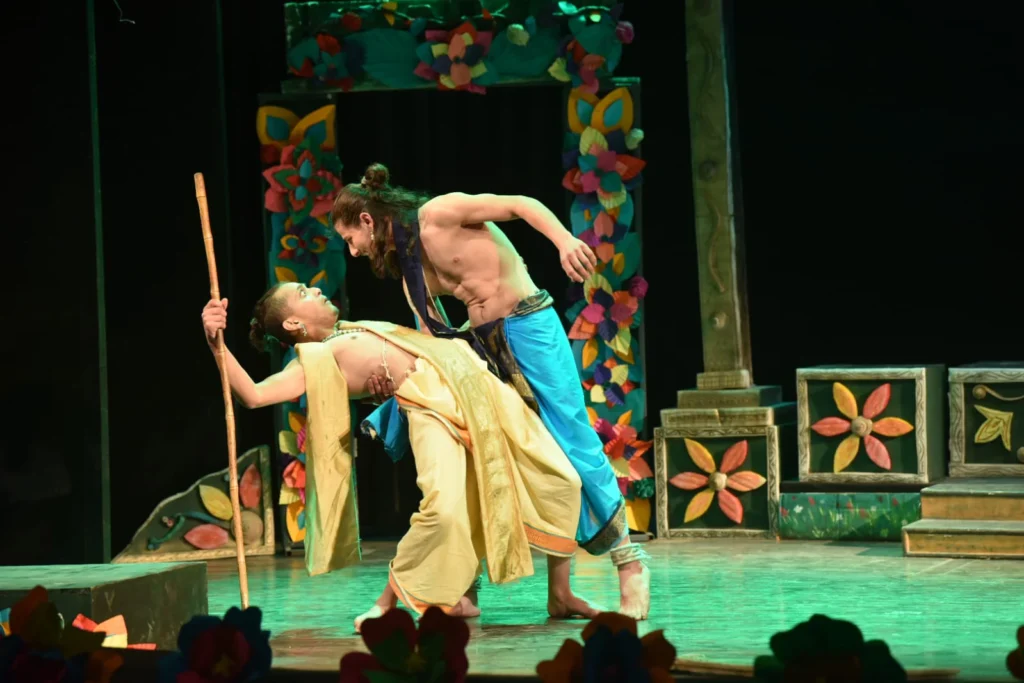
The stage design and use of properties were larger than life, and from the very first scene, the production demonstrated confident incident management that successfully drew the attention of the spectators. The visual treatment, coupled with disciplined movement and clarity of presentation, placed the play among the strongest performances of the festival, eventually emerging as one of the best among the five plays staged.
A special mention must be made of the actor portraying King Dushyanta’s friend, whose performance stood out for its natural ease, expressive delivery, and emotional balance. The role added warmth and rhythm to the narrative, becoming one of the highlights of the production. Overall, the play offered a well-crafted and engaging theatrical experience, doing justice to the grandeur and depth of Kālidāsa’s classic.
The third play staged was Othello, presented by the Centre of Excellence, Sanjauli College. Directed by Ajay Sharma and overviewed by Bharti Bhagra, the production took on one of Shakespeare’s most powerful and layered tragedies—an ambitious choice that naturally raised expectations.
While Shakespeare’s text remains compelling and timeless, this production proved to be stronger in words than in action. The dialogues carried weight, but the emotional reactions and internal conflicts essential to the characters were not fully translated into performance. The actors often struggled to embody the psychological depth and intensity that Othello demands, resulting in moments where the narrative felt restrained rather than explosive.

The decision to significantly shorten the duration of such a massive and complex play further diluted its impact. Key emotional transitions and motivations appeared rushed, leaving little space for tension to build or relationships to evolve organically. As a result, the production, despite its literary strength and intent, fell short in execution, missing the dramatic force that defines Shakespeare on stage.
Last but not least came The Web, directed by Kedar Thakur and performed by Rajiv Gandhi Government College, Chaura Maidan, Shimla. At the outset, the play was positioned as a commentary on the growing menace of chitta (drug abuse) in Himachal Pradesh. However, as the narrative unfolded, it became evident that the production was an adaptation of a story inspired by Albert Camus, earlier staged in November 2025 under the title Bhramdosh.
The opening scene relied heavily on direct verbal messaging, resembling a spoken social lecture rather than a theatrical performance. Instead of allowing the issue to emerge organically through action and conflict, the play chose to announce its intent upfront, weakening its dramatic engagement.
Among all the productions staged during the festival, The Web emerged as the weakest. A major setback was the technical execution—most notably the crucial gufa (cave) sequence, which depended heavily on lighting but was lost in darkness, robbing the scene of its intended impact and symbolism.
The strongest element of the play was the actor portraying the mother, whose performance carried emotional weight and sincerity. However, audience reaction during certain scenes raised deeper concerns. Moments depicting the parents slapping their son for his addiction were met with loud whistles and claps, suggesting an unsettling approval of violence. In contrast, the quieter, more sensitive moments—where the mother breaks down, cries, and tries to comfort her son—failed to evoke a similar response.
This contrast in audience reaction exposes a troubling reflection of the present mindset, where aggression appears to excite more than empathy. It points toward a deeper issue: not just drug abuse, but a generation increasingly desensitised and triggered by violence in any form. The Web unintentionally became a mirror—not only of addiction, but of a growing psychological shift among youth, raising an urgent question about where society is headed and what truly drives this restlessness beyond substance abuse alone.