
Second Stakeholder Consultation on the Himalayan Agroecology Initiative
2 min read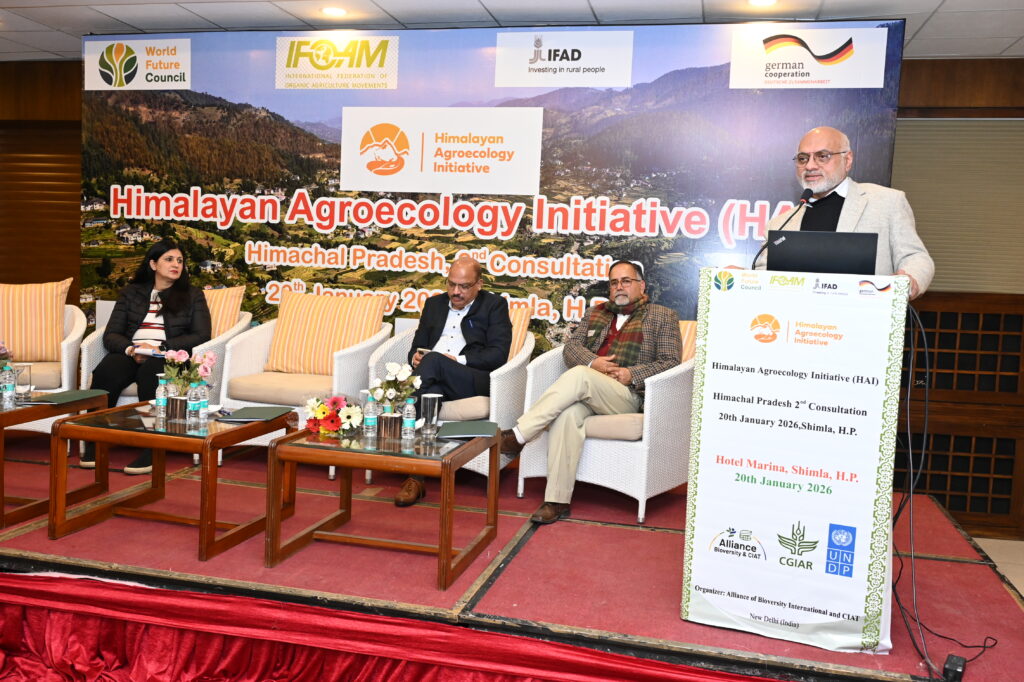
The Second Stakeholder Consultation on the Himalayan Agroecology Initiative (HAI) Road Map was held on 20 January 2026 at Hotel Marina, Shimla, with the objective of deliberating on the draft HAI Road Map for Himachal Pradesh and strengthening policy convergence to advance agroecological transitions in the state.
The consultation forms part of an ongoing multi-country, multi-stakeholder HAI process aimed at co-developing practical, evidence-based pathways for sustainable, climate-resilient, and nutrition-sensitive food systems across the Indian Himalayan Region.
The meeting focused on presenting the HAI Road Map and its seven strategic pillars, assessing their relevance for Himachal Pradesh, and aligning agroecology priorities with existing state initiatives on natural farming, horticulture, livestock, climate action, nutrition, and rural livelihoods. The Road Map was highlighted as a guiding framework for operationalizing state and national schemes in ways that respond to the unique agro-ecological and socio-economic conditions of the Himalayan region.
In his keynote address, Dr. Basu Sood, Advisor (Planning), Government of Himachal Pradesh, emphasized the strategic importance of agroecology in reducing climate and livelihood risks in hill agriculture. He stressed the need for long-term policy commitment, convergence in planning, and strong institutional coordination, while cautioning against disrupting the balance between food crops and cash crops. He assured full state support for initiatives that strengthen the agricultural sector and enhance farmer welfare.
Dr. Jai C. Rana, India Country Representative, Alliance of Biodiversity International–CIAT, presented the HAI Road Map, highlighting its food-systems approach, alignment with national missions on natural farming, climate change, nutrition, and biodiversity, and its relevance to the Viksit Bharat vision. He underlined that transforming food systems is no longer optional but essential, and called for a shift from sector-based to multi-sectoral and participatory approaches.
Sh. Suresh Sharma, Director-cum-State Nodal Officer, RGPKKKY, shared insights on the progress and achievements of natural farming in Himachal Pradesh. He outlined key challenges, including small landholdings, rain-fed agriculture, and declining youth interest in farming, while highlighting opportunities for convergence with the HAI framework—particularly through strengthened producer–consumer linkages.
During the open discussions, participants emphasized the need for enhanced inter-departmental coordination, capacity building, integration of agrobiodiversity with soil and water stewardship, development of equitable value chains, branding and certification, private sector engagement, cluster-based approaches, food and nutrition education, and greater support for women-led and community-based institutions.
The consultation brought together senior state officials, representatives from NABARD, research and academic institutions, development partners, civil society organizations, farmer producer organizations (FPOs), and farmers. The inputs and recommendations from the consultation will be incorporated into the final HAI Road Map for Himachal Pradesh, positioning it as a practical tool for policy alignment, institutional coordination, and investment planning.
Participants were welcomed by Dr. Lal Singh, HAI Consultant for Himachal Pradesh, and the vote of thanks was delivered by Ms. Sonal Dsouza, Alliance New Delhi. The HAI is funded by Germany’s BMZ and IFAD, and is implemented in partnership with WFC, IFOAM–Organics International, Alliance of Biodiversity International–CIAT, and UNDP (India).