
Editorial: Walls Remember What Authorities Forget
3 min read
Shimla, Nov. 26 Ritanjali Hastir
A deeply uncomfortable question needs an answer, “What does ‘beautification and cultural representation’ really mean in Shimla today?”
Shimla, a city admired across the country for its beauty and culture, continues to draw tourists in large numbers. Yet behind this postcard charm lies a disturbing reality that reflects both negligence and misplaced priorities.
A couple of years ago, the Mall Road and its adjoining areas were adorned with a series of wall paintings under a ‘beautification’ initiative. One such painting near Sher-e-Punjab, created by a local artist at an approximate cost of ₹30,000, now stands as a tragic example of utter neglect. What was once a vibrant depiction of nature-green fields, rolling hills and mountain silhouettes under a blue sky has deteriorated beyond recognition. Large sections of paint have peeled away, exposing a rough, grey underlayer of concrete. The surface is cracked, broken and scattered with flaky remnants of colour. Time, moisture and harsh weather have reduced the artwork to an abstract, almost ghost-like impression of what once existed.
Adding insult to injury, a ‘Home Tuition’ pamphlet is now shamelessly pasted at the centre of the ruined painting, turning a cultural expression into an illegal advertisement board.
The irony is unmissable. Just a few metres away, a board mounted by the Municipal Corporation of Shimla clearly reads:
“No Pasting on Walls – Keep Shimla Clean & Green.”
The wall, however, tells an entirely different story. Today, the painting has been hijacked by layers of random posters, pasted in open defiance of the very authority that claims to protect it.
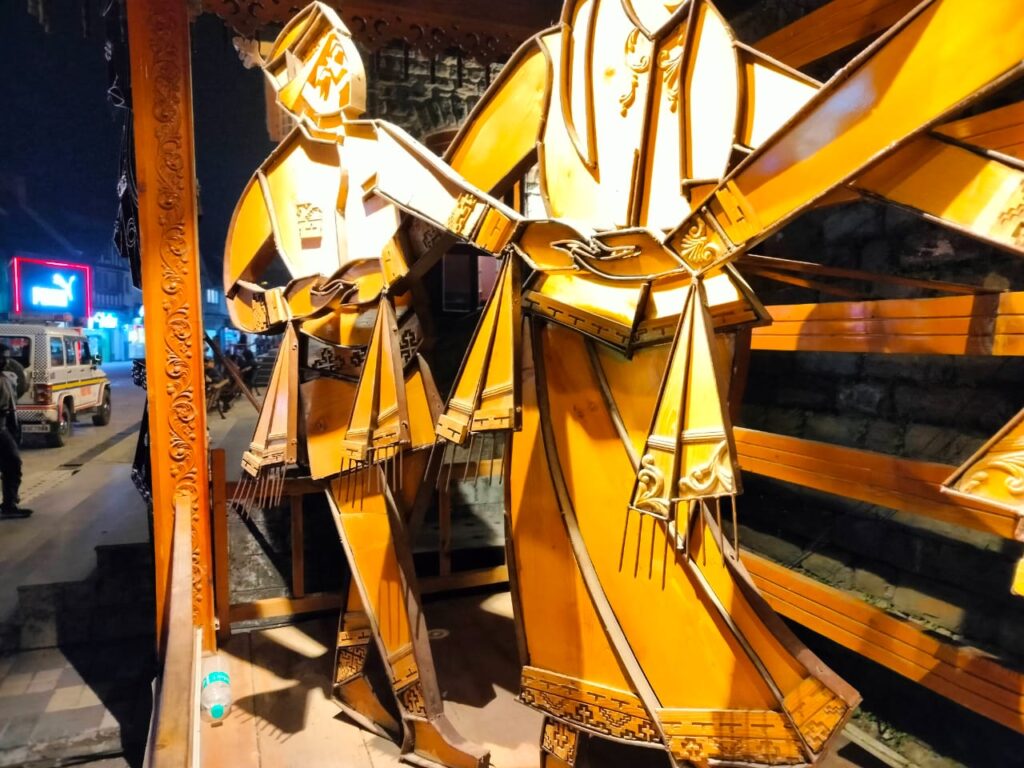 A short walk from this wall lies another neglected treasure—the Himachali Nati mural by Prof. Him Chatterjee, situated adjacent to the Reporting Room on Mall Road. Intended to celebrate Himachal’s vibrant tradition and offer tourists a glimpse into its rich cultural identity, the mural has instead been reduced to a mere photo prop. Visitors regularly step over the artwork, place their shoes, bags and water bottles on its surface, and often leave behind plastic waste, as if it were nothing more than a pavement.
Thousands of photographs get taken at such culturally alive spots and shared on social media. Yet, in this sea of images, respect for the artwork and what it represents is remains completely absent.
Is it limited to spending public money, painting walls and posing for pictures? Or does it mean preserving heritage, maintaining public art and instilling civic responsibility?
The reality today is hard to ignore as the art created with public funds is being casually destroyed. Cultural symbols are being treated like doormats and most damaging part that the Municipal rules exist only on signboards—not in practice. There is no visible system to protect, maintain or even respect public art.
Looking at the current scenario, another painful old example comes to mind, the missing chain from the mural, ‘Duty with Love’ by Prof. M.C. Saxena outside the Reporting Room. What makes this neglect even more alarming is the fact that both the damaged murals— ‘Duty with Love’ and the ‘Himachali Nati’ are located right outside the Reporting Room, under the very eyes of the police. If art created in honour of duty, discipline and cultural pride cannot be protected in the immediate vicinity of a security check-post, it exposes a deeper failure of our custodial systems.
The loss of the chain and the current mistreatment of the Nati mural are not just acts of public indiscipline; they are silent indictments of those responsible for safeguarding public property. When such damage happens right at the doorstep of authority, it is hard not to see it as sheer apathy rather than ignorance.
Our custodians of public property may be eager to inaugurate new projects, but they show little concern for preserving what has already been created. In the end, the question remains unanswered. If we cannot protect a shepherd and his lamb on a wall, or honour a traditional Nati in the heart of our capital, how can we claim to respect our culture at all?
Shimla does not need more paint. It needs accountability. It needs memory. And above all, it needs respect.