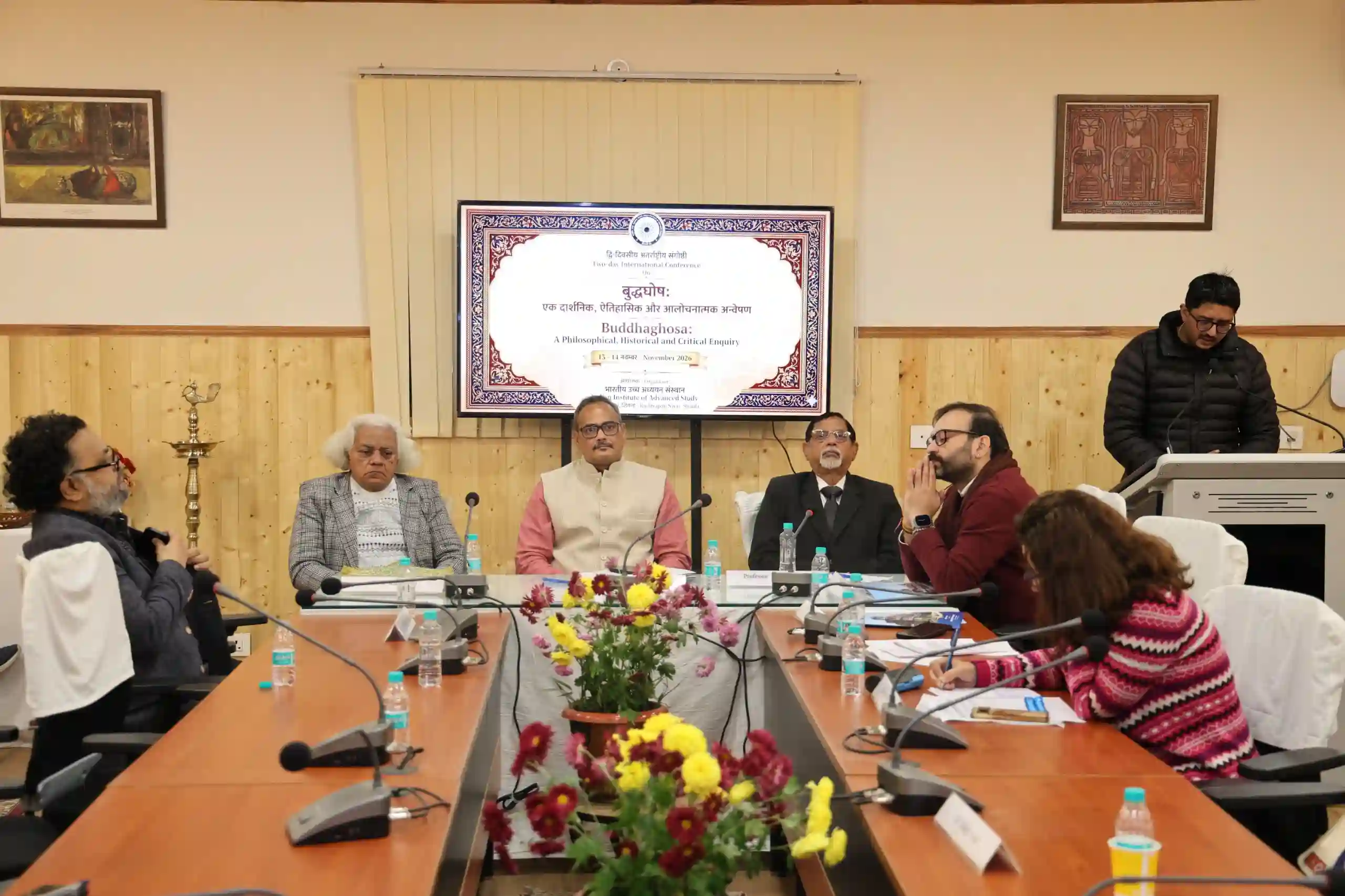

Two-Day International Conference on ‘Buddhaghosa: A Philosophical, Historical and Critical Enquiry’ Concludes at the Indian Institute of Advanced Study
Extensive Academic Deliberations on Buddhaghosa’s Philosophical Thought, Intellectual Legacy and Dialogue with Various Traditions of Indian Philosophy
Shimla, 14 November 2026: The two-day international conference on ‘Buddhaghosa: A Philosophical, Historical and Critical Enquiry’, organised at the Indian Institute of Advanced Study (IIAS), Rashtrapati Nivas, Shimla, concluded today. Held on 13 and 14 November, the conference brought together scholars, faculty members and research scholars from various universities and academic institutions across the country to deliberate in depth on the diverse dimensions of the ideas, writings and philosophical contributions of Buddhaghosa, a prominent philosopher and scholar of the Theravāda Buddhist tradition.
The valedictory session marking the conclusion of the conference was chaired by Prof. Balaganapathi Devarakonda, Professor, Department of Philosophy, University of Delhi. The session commenced with a welcome address by Prof. Sanjai Bhatt, Fellow, Indian Institute of Advanced Study. This was followed by a detailed conference report presented by Dr. Sudeep Raj Kumar, Convener of the conference and Assistant Professor, Hindu College, University of Delhi. He summarised the academic sessions held over the two days, the research papers presented and the deliberations on various themes.
On the occasion, Prof. (Dr.) S. Ranganath, Former Fellow, Indian Institute of Advanced Study, delivered the valedictory address. He shared his scholarly insights and academic perspectives on the theme of the conference. Thereafter, the Chair, Prof. Balaganapathi Devarakonda, shared his concluding remarks.
The valedictory session was moderated by Dr. Akhilesh Pathak, Sales and Public Relations Officer, IIAS, who conducted the proceedings and proposed the formal vote of thanks on behalf of the Institute. The conference formally concluded with the National Song and the National Anthem.
The primary objective of the two-day conference was to re-examine Buddhaghosa’s philosophical and intellectual contributions from historical, conceptual, commentarial and comparative perspectives. Rather than viewing Buddhaghosa merely as a commentator on Pali Buddhist texts, the conference sought to understand him as a thinker who played a significant role in interpreting, reinterpreting and systematically presenting the concepts of Buddhist philosophy. Particular emphasis was placed on understanding, through his ideas, the broader intellectual traditions of Indian philosophy and the dialogue among different philosophical schools.
The academic sessions held on the first day of the conference explored philosophical questions relating to causality, time and continuity in the Visuddhimagga, along with Buddhaghosa’s ideas on philosophical psychology. Research papers were presented on subjects such as the mind, emotions, Brahmavihāras, mindfulness and well-being.
The sessions held on the second day focused on Buddhaghosa’s contributions as a commentator, his life, language and intellectual legacy; comparative and cross-cultural philosophical perspectives; and his legacy from literary, doctrinal and regional viewpoints. Scholars examined Buddhaghosa’s ideas in the context of other Buddhist and non-Buddhist philosophical traditions and presented research papers addressing questions concerning the self, non-self (anattā), time, consciousness, ethics and various philosophical concepts.
An important question that remained central to the deliberations throughout the conference was whether Buddhaghosa’s writings should be viewed merely as interpretations and compilations of earlier Buddhist teachings or whether he should also be recognised as an independent and creative philosophical thinker. In this context, discussions explored the creative role of his commentarial literature, his methods of interpreting classical texts and the contemporary reinterpretation of ancient philosophical ideas.
Scholars from various universities and academic institutions participated in the conference both in person and online. Besides encouraging academic dialogue in the fields of Buddhist philosophy, Indian intellectual history and comparative philosophy, the conference provided an important platform for an in-depth and multidimensional study of Buddhaghosa’s philosophical contributions.
Samagra Sikhsha