
Editorial : One Ridge, Two Rulebooks
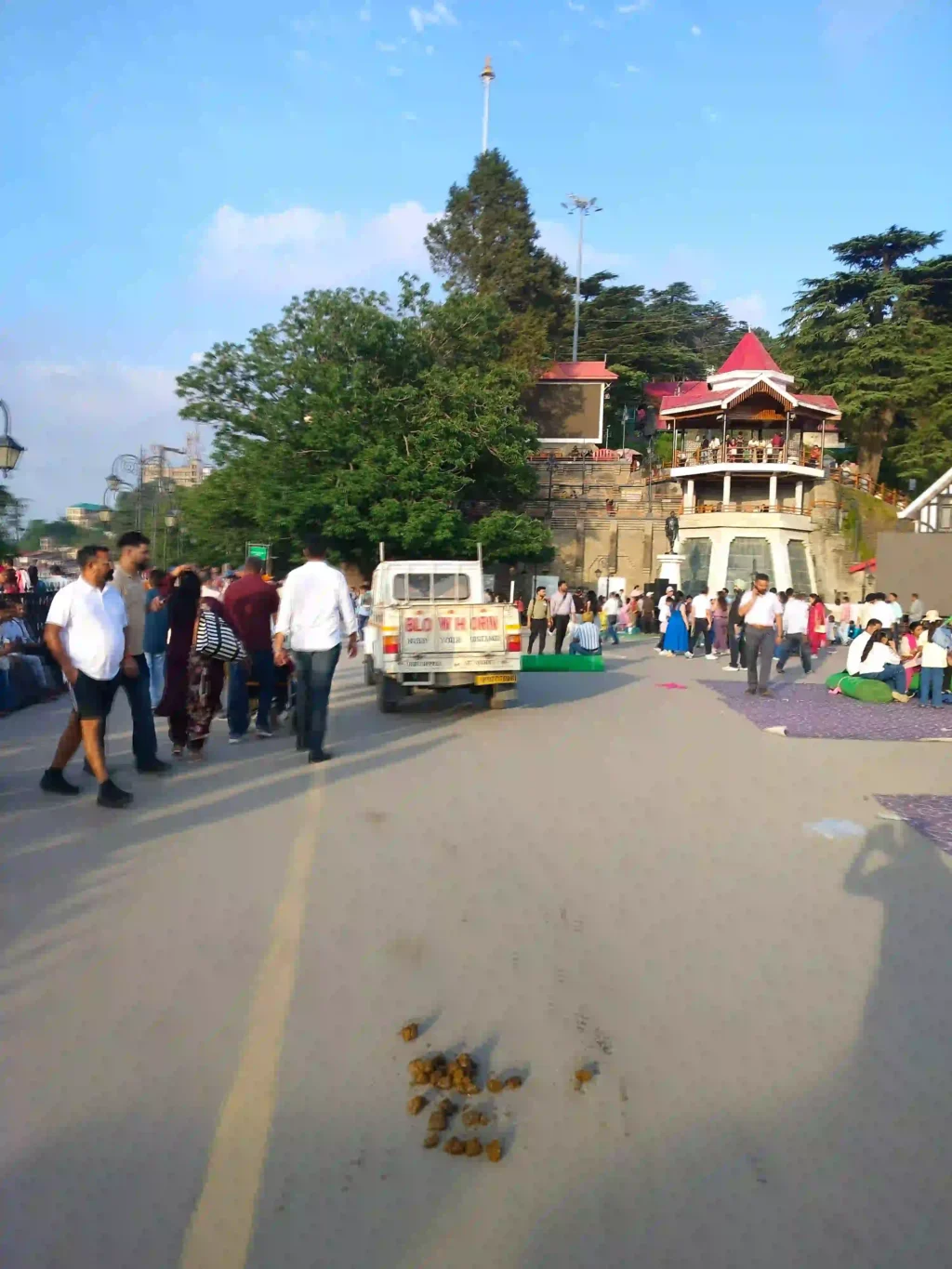
SMC vehicle caught on camera, crossing the yellow line!
Shimla, June 21 Ritanjali Hastir
Every Shimla resident is familiar with the yellow line on the Ridge. We are repeatedly reminded that this is a no-vehicle zone. The Ridge sits above historic water reservoirs. The city falls in Seismic Zone IV. Experts, officials and reports have warned for years about the sensitivity of the area and the need to exercise caution.
Yet one cannot help but ask: if the Ridge is so sensitive, why do the rules appear to change whenever a major event is planned?
On ordinary days, vehicles crossing the Ridge attract criticism because the space is meant for pedestrians. Citizens are expected to respect regulations. Concerns about structural load, crowd management and public safety are frequently cited. However, during major festivals, the same Ridge is expected to accommodate thousands of people. Massive stages are erected, heavy equipment is transported, crowds gather late into the evening and the concerns that dominate official discussions for the rest of the year suddenly vanish.
The contradiction is difficult to ignore.
If the Ridge can safely host thousands dancing during the Summer Festival, if it can accommodate large public gatherings, and if boxing rings and other event infrastructure can be installed there, then the public deserves a transparent explanation of why the same space is routinely presented as too fragile for other activities.
Shimla residents may recall earlier debates over holding boxing matches on the Ridge. At the time, many questioned whether the city’s most important heritage space should repeatedly be converted into an event arena. Those concerns were never fully answered. Instead, the city continues to oscillate between two narratives: one in which the Ridge is an extremely sensitive heritage structure requiring protection, and another in which it functions as the preferred venue for every major public spectacle.
Both positions cannot be true without clear scientific justification.
The issue is not whether festivals should be held. Nor is it whether cultural events should stop. The issue is consistency. Rules must apply equally. Safety concerns cannot be invoked selectively. If vehicles crossing the Ridge are a problem, then they should be a problem regardless of who owns the vehicle. If crowd pressure threatens the Ridge, then that concern should not disappear simply because an event attracts publicity or tourism revenue.
Shimla deserves clarity. The government, Municipal Corporation and all concerned agencies should place in the public domain the carrying-capacity studies, structural assessments and safety evaluations on which permissions are granted. Citizens have a right to know how many people the Ridge can safely accommodate, what activities are permissible and where the line is drawn.
Until then, many residents will continue to ask a simple question: Is the Ridge a protected heritage space, or is it an event ground? Because at present, it appears to be whichever version is convenient on a given day.
Samagra Sikhsha