
Self-Reliance in Seed Production is the Backbone of Sustainable Agriculture
February 20, 2026
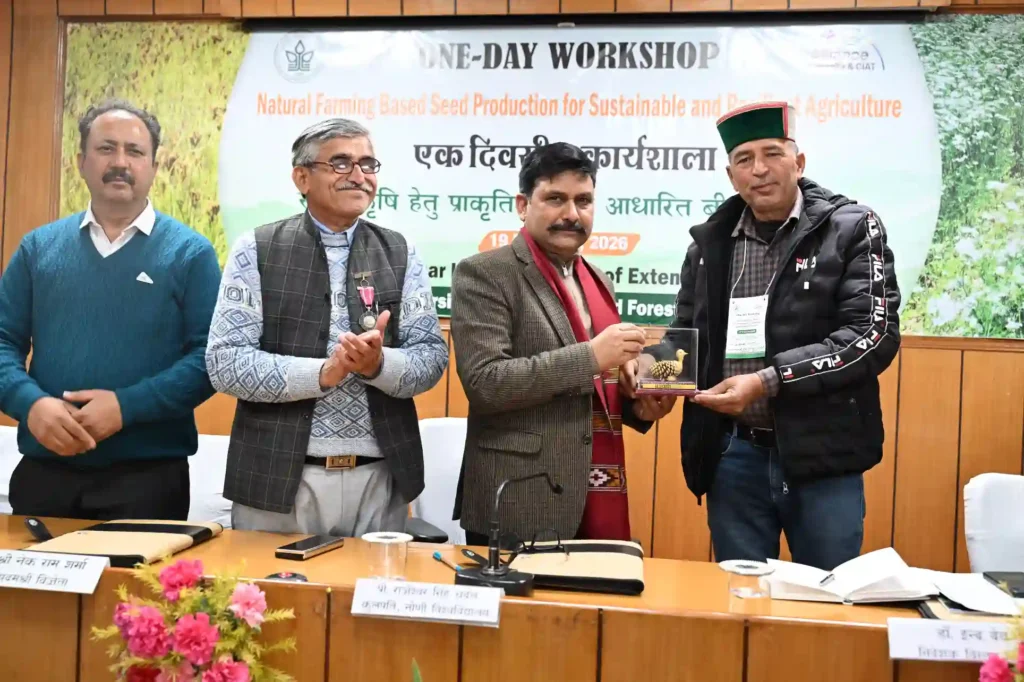
A one-day workshop on Natural Farming-Based Seed Production for Sustainable and Resilient Agriculture was organized at the Dr. Y.S. Parmar University of Horticulture and Forestry on Thursday. The workshop brought together nearly 200 farmers representing Farmer Producer Companies (FPCs) from Chamba, Mandi, Sirmaur, Hamirpur, Shimla and Solan districts, along with representatives of NGOs engaged in seed conservation initiatives, ICAR NBPGR Shimla and scientists from the university.
Addressing the participants, Vice-Chancellor Prof. Rajeshwar Singh Chandel emphasized that seeds are the very foundation of agriculture and the key to ensuring long-term sustainability. Highlighting the importance of seed sovereignty in natural farming, he said that the ownership and control of natural farming seeds must remain with farmers. “Local seeds are gradually disappearing from our homes and communities. We must revive the culture of saving, sharing and conserving them,” he remarked.
Prof. Chandel observed that Himachal Pradesh is fortunate to still have farmers who possess traditional knowledge about indigenous seeds. He called for harnessing this wisdom and systematically conserving native seed varieties for future generations. Describing seed production as a promising livelihood opportunity, he urged FPCs to transform collective knowledge into collective action and develop farmer-led seed enterprises that ensure both sustainability and profitability.
Dr. J.C. Rana, Country Representative of the Alliance of Bioversity International and CIAT, highlighted self-dependence in seed production as a cornerstone of sustainable agriculture. Applauding Himachal Pradesh’s natural farming movement, he said that achieving self-reliance in seed systems would require strong collaboration between public institutions, private stakeholders and farming communities. He stressed that maintaining quality standards and discipline would be essential to compete in wider markets. Dr. Rana also called for improved packaging and value addition of locally produced food products and encouraged the university to support such initiatives.
Dr. Rana elaborated on the Himalayan Agroecology Initiative (HAI), which aims to strengthen food systems resilience in the Himalayan region. He shared the HAI Roadmaps are expected to help inform the thinking and action of high-level decision makers and key influential actors while enabling local stakeholders to engage in food policy processes and achieve more impact in strengthening agroecology policy environments. He further informed about its seven strategic pillars, emphasizing farmer-centric, climate-resilient and ecologically grounded transitions. According to him, the roadmap will guide high-level policymakers and key stakeholders while enabling local communities to engage meaningfully in food policy processes and enhance the impact of agroecological practices.
Samagra Sikhsha