
Focus on Agripreneurship and Value Chains at ICAR Winter School in Nauni
Solan, February 17, 2026
A 21-day ICAR-sponsored Winter School on ‘Fostering Agripreneurship through Processing and Optimized Value Chains for Horticultural Crops Integrated with Circular Strategies for Waste Upcycling and Economic Resilience’ concluded at Dr YS Parmar University of Horticulture and Forestry, Nauni. The programme was organized by the Department of Food Science and Technology. Nineteen participants from 10 universities and two Krishi Vigyan Kendras (KVKs) representing Odisha, Andhra Pradesh, Uttar Pradesh, Haryana, Punjab, Gujarat, and Himachal Pradesh participated in the programme.
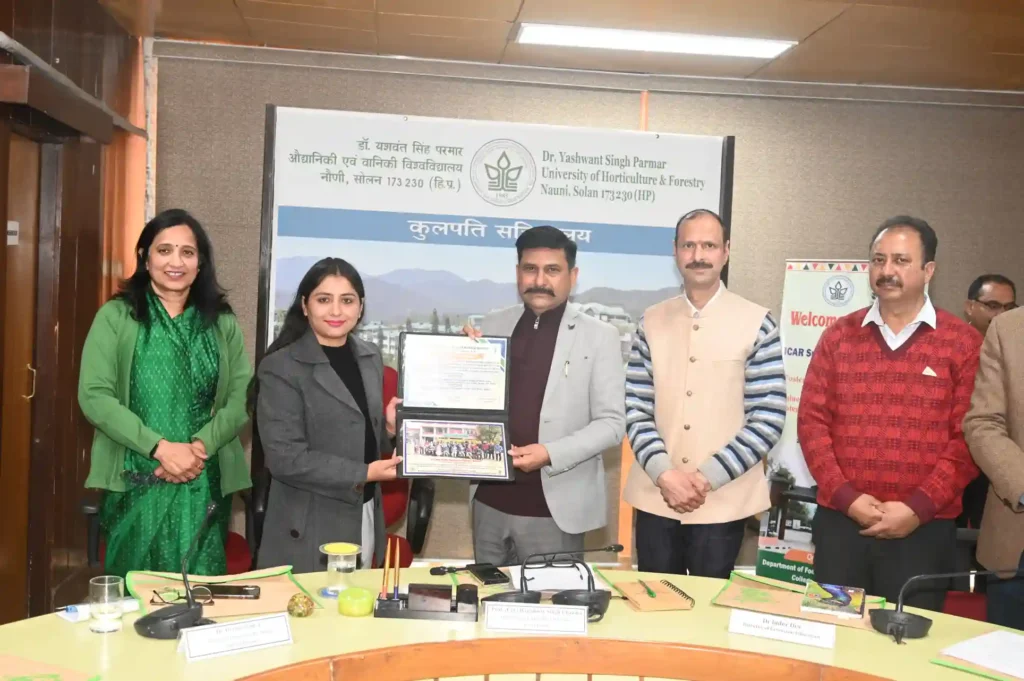
Addressing the valedictory session on Monday, Vice Chancellor Prof. Rajeshwar Singh Chandel emphasized the need to rethink contemporary researchable issues in horticulture and allied sectors. He stated that such training programmes create meaningful and critical discourse on value addition, post-harvest management, supply chain optimization and circular economy frameworks. These deliberations, he noted, are essential for developing evidence-based and market-responsive agripreneurial models aligned with national and global priorities.
Prof. Chandel expressed confidence that the knowledge disseminated and skills acquired during the Winter School would translate into scalable models of sustainable horticultural enterprises, improved income opportunities for farming communities, and strengthened resilience of agri-food systems. He reiterated the University’s commitment to nurturing innovation-driven, socially responsible and environmentally sustainable agripreneurs who can contribute meaningfully to inclusive rural development and national food and nutritional security. He further emphasized that scientists must work closely with Farmer Producer Companies (FPCs) to help them identify and develop their unique selling propositions (USPs), thereby enhancing their competitiveness in the market. He also stressed that the carbon footprint of every technology developed should be carefully evaluated to ensure environmental sustainability and alignment with climate-resilient agricultural practices.
Earlier, Director of Research Dr. Devina Vaidya highlighted that scientific interventions are vital to enhancing efficiency, quality, and profitability across the horticultural value chain. She noted that advancements in post-harvest technology, food processing, biotechnology and bioengineering have opened new avenues for converting horticultural produce and residues into high-value products. Such training programmes, she said, enhance understanding of advanced processing technologies and innovative value addition strategies. Practical exposure to circular economy approaches further strengthens entrepreneurial acumen, business planning skills, and market intelligence necessary for competitive agripreneurship.
Course Director and Head, Department of Food Science and Technology, Dr. Rakesh Sharma, informed that the training programme was strategically designed to strengthen the intellectual, technological, and entrepreneurial capacities of stakeholders in the horticulture sector. He added that the Winter School facilitated interdisciplinary networking, collaborative research and institutional partnerships, while fostering critical discussions on value addition, post-harvest management, supply chain optimization and circular economy frameworks. As part of the training, expert lectures and exposure visits were organized to the University Model Farm, Natural Farming Model, HimAgri Solutions Unit, Dilman Delicacies, Minchy’s, Directorate of Mushroom, KVK Kandaghat, and RHRTS Mashobra, Shimla, providing participants with practical insights into processing technologies, enterprise models, and value chain optimization.
Samagra Sikhsha