
Students get Insights on Green Revolution and Future Agricultural Challenges
February 15, 2026
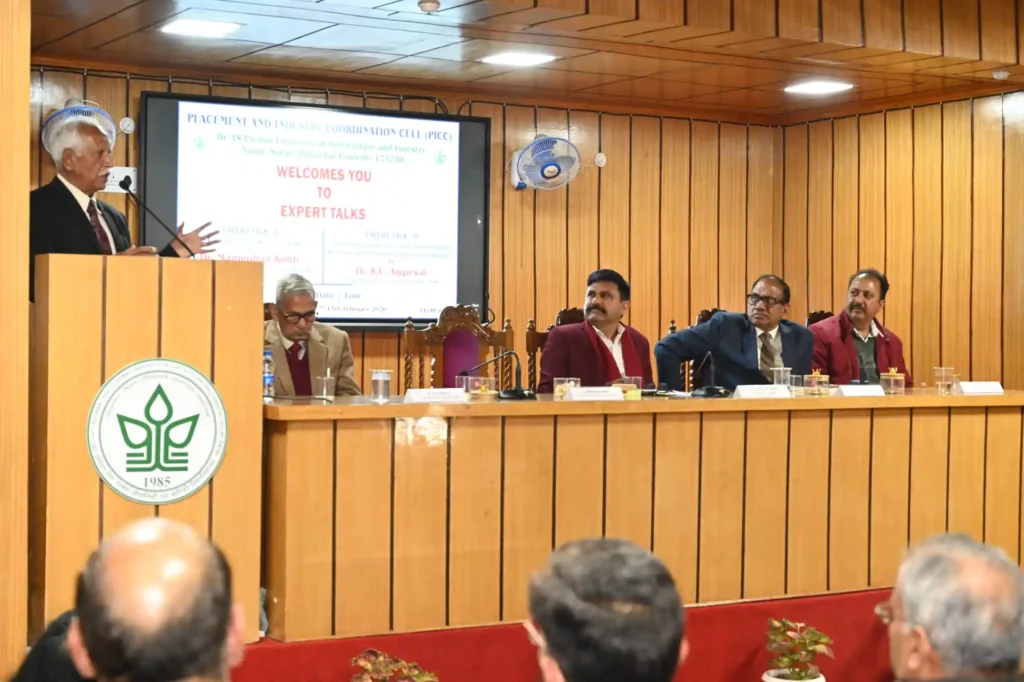
Renowned wheat geneticist and plant breeder Dr. Manmohan Kohli delivered an insightful expert lecture, sharing his vast experience in wheat genetics, breeding and germplasm improvement. The expert talk was organized by the Placement and Industry Coordination Cell of Dr. Y.S. Parmar University of Horticulture and Forestry.
Dr. Kohli is internationally recognized for his pioneering contributions to the development of disease-resistant wheat varieties. Dr Kohli did his early schooling from Solan and began his global research career at the International Maize and Wheat Improvement Center (CIMMYT), Mexico, where he worked closely with Nobel Laureate Norman Borlaug. His work significantly strengthened wheat genetics and breeding programmes, with a strong focus on disease resistance and hybridization strategies.
Addressing faculty and students, Dr. Kohli reflected on the Green Revolution and explained how improved varieties transformed India’s agricultural landscape. He paid tribute to the unsung heroes who played a crucial role in making the Green Revolution a success. Emphasizing present-day challenges, he stated that while climate change poses serious threats to agriculture, collective scientific efforts and technological innovation can help develop resilient solutions. He urged faculty members and students to adopt interdisciplinary learning approaches, stressing that modern agricultural challenges require integrated scientific knowledge. He also emphasized the importance of disseminating accurate and timely information to farmers, cautioning that incorrect guidance can adversely affect crop productivity. Dr. Kohli highlighted teamwork as a cornerstone of successful research and extension efforts.
Dr. R.C. Agrawal, Former Deputy Director General (Agricultural Education), ICAR, delivered a detailed presentation on the implementation strategies of the National Education Policy (NEP) 2020 in agricultural education. He also discussed the National Agricultural Higher Education Project (NAHEP) and its transformative impact on strengthening agricultural education across the country. Dr. Agrawal further spoke about the “Gene Revolution” in agriculture and underscored the need for self-sustaining agricultural programmes. Dr KK. Jindal, Former Director of Research of the university, also shared his views on the impact of climate change on hill horticulture.
Prof. Rajeshwar Singh Chandel, Vice Chancellor of the university, appreciated the deliberations and emphasized that the university’s scientists and students must continue working towards developing innovative, climate-resilient technologies for the benefit of farming communities.
Samagra Sikhsha