
District Administration Brainstorms Strategy to Punish Chitta Smugglers
Shimla:
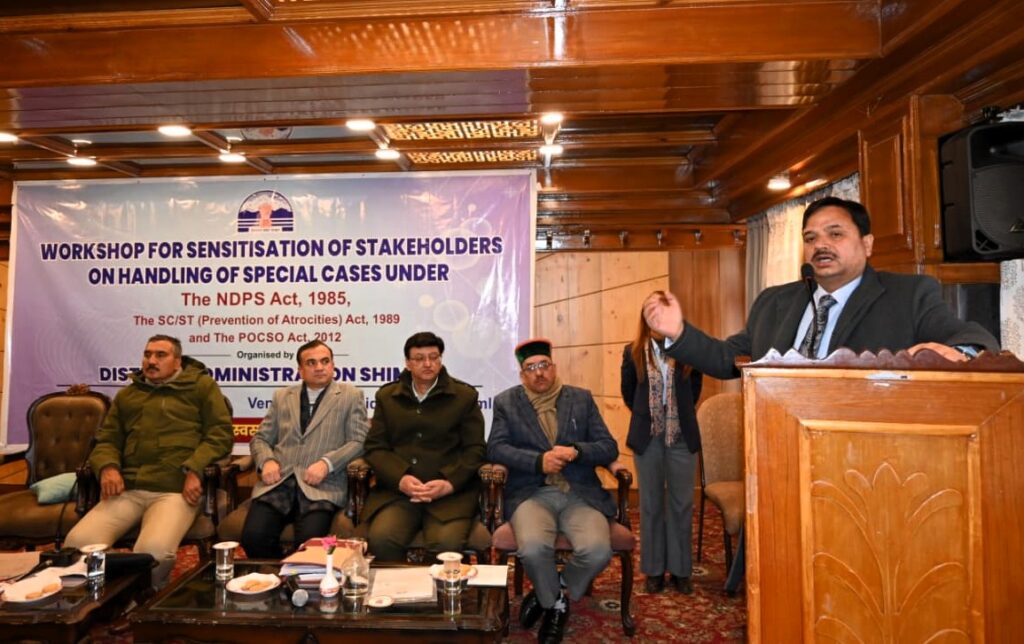
Reiterating its commitment to delivering justice and making Himachal Pradesh drug-free, the Shimla District Administration on Tuesday organised a one-day special workshop on the NDPS Act, 1985; SC/ST Act, 1989; and POCSO Act, 2012 at Hotel Holiday Home.
For the first time, such an inclusive and comprehensive workshop was held in the district, bringing together all key stakeholders on a single platform. The session focused on devising specific and effective strategies to ensure strict punishment for drug smugglers, particularly those involved in the Chitta menace.
The workshop was attended by all SDMs, DSPs, District Attorneys, Prosecution Officers, Assistant Attorneys, SHOs, and representatives from the Health Department. The initiative aligns with the state government’s resolve to make Himachal Pradesh a drug-free state, with emphasis on ensuring speedy and effective convictions.
Providing Justice Is Our Priority: DC Anupam Kashyap
Addressing the gathering, Deputy Commissioner Anupam Kashyap said that ensuring justice for people in cases registered under the NDPS, SC/ST, and POCSO Acts must be the collective responsibility of all stakeholders. He emphasized that Himachal Pradesh, known as the land of gods and goddesses, demands a higher standard of governance and justice delivery.
“If we fail to provide justice to victims, we must introspect and improve our working methods,” he said. Highlighting the impact of poor conviction rates, he added that repeated acquittals weaken public trust in the administration and embolden criminals. “When victims receive justice, their smile motivates us. But a high acquittal rate removes fear of the law and encourages repeat offences,” he warned.
The Deputy Commissioner stressed that strong investigations form the foundation of successful prosecution, and such workshops aim to align all departments to work cohesively towards justice.
Investigations Must Be Impartial and Fact-Based: SSP Sanjeev Kumar Gandhi
Senior Superintendent of Police Sanjeev Kumar Gandhi expressed concern over the high acquittal rates in cases under NDPS, SC/ST, and POCSO Acts. Drawing from his 27 years of policing experience, he said investigations must be conducted swiftly, independently, impartially, and on factual grounds.
He cautioned investigating officers against forming preconceived conclusions. “The objective is not merely to prove the FIR allegations but to uncover the truth. Bias compromises investigations and ultimately weakens cases in court,” he said.
Low Conviction Rates a Matter of Concern
District Attorney Sudhir Sharma presented detailed data highlighting conviction trends:
POCSO Act (2021–2025):
Total cases reaching court: 138
Convictions: 49
Acquittals: 89
Overall conviction rate: 35%
NDPS Act (2021–2025):
Total cases registered: 391
Convictions: 98
Acquittals: 293
Conviction rate: 26%
Year-wise data revealed fluctuating but generally low conviction rates, underlining the need for stronger investigation and prosecution mechanisms.
Expert Lectures and Ground Challenges Discussed
The workshop also featured special lectures by experts:
ASP Mehar Panwar explained key provisions of the POCSO Act, 2012
Dr Vivek Sahajpal, Assistant Director, Directorate of Forensic Services, elaborated on DNA profiling
CMO Dr Yashwant Ranta discussed MLC and post-mortem procedures, addressing queries of investigating officers
Dr Praveen S. Bhatia, Deputy Medical Superintendent, IGMC, highlighted alarming trends in Chitta abuse, including exploitation of girls and dangerous new methods of drug consumption among youth
During the session, departments shared field-level challenges and agreed to work jointly on future strategies to strengthen investigations, improve conviction rates, and ensure timely justice for victims.
Samagra Sikhsha